&
& 

Legionella bacteria live naturally in water. In building water systems, they can multiply and cause Legionnaires’ disease, a potentially fatal pneumonia, when people breathe in contaminated droplets. Employers and people in control of premises, including landlords, must assess and control the risk.
Who needs a legionella risk assessment?
Anyone who is an employer, self-employed or in control of premises where water systems could create a risk, which includes most workplaces and rented homes. The duties come from the Health and Safety at Work etc. Act 1974 and COSHH, and HSE’s Approved Code of Practice L8 explains how to comply.
When the risk is higher
- Water is stored or recirculated
- Water temperature is between 20°C and 45°C, where legionella grows best
- There are deposits such as rust, scale or sludge for bacteria to feed on
- Water droplets or spray are produced, such as from showers, spray taps or cooling towers
- People are more vulnerable, such as older people, smokers or those with weakened immune systems
- Outlets are rarely used, or there are dead legs where water stagnates
What the risk assessment covers
- Appoint a competent person, sometimes called the responsible person, to manage the risk.
- Identify and describe the water systems, with a schematic diagram.
- Identify where the risks are, including stagnant water and the temperature range for growth.
- Decide on and record control measures.
- Set up monitoring, inspection and maintenance, and keep records.
- Review the assessment regularly and whenever there is reason to think it is no longer valid.
Key control temperatures
| System | Target |
|---|---|
| Hot water storage, such as a calorifier | Stored at 60°C or above |
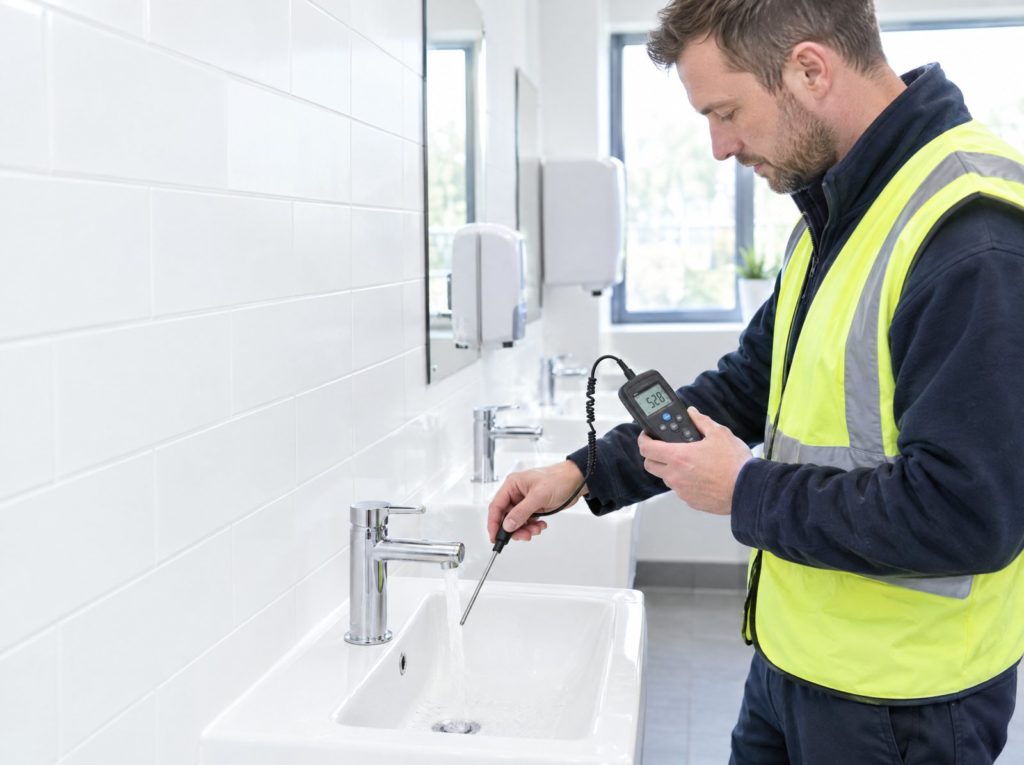
| Hot water outlets | Reach at least 50°C within one minute of running (55°C in healthcare premises) |
| Cold water outlets | Below 20°C within two minutes of running |
| Little-used outlets | Flushed at least weekly |
Where hot water at these temperatures creates a scalding risk, such as in care settings, thermostatic mixing valves are fitted as close to the outlet as possible and the scalding and legionella risks are managed together.
Records
Keep records of the risk assessment, the person responsible, the control scheme and the results of monitoring, inspection and checks. HSE advises keeping records for at least five years.
Cooling towers
Cooling towers and evaporative condensers carry a higher risk and must be notified to the local authority. They need a specific written control scheme, regular treatment and monitoring.
Training that helps
Our legionella awareness eLearning gives staff and managers a clear understanding of the risks and controls. For managers who oversee building safety, the NEBOSH National General Certificate covers biological hazards and the management of workplace risks.
Frequently asked questions
Is a legionella risk assessment a legal requirement?
Yes. Employers and those in control of premises must assess and control the risk from legionella, including landlords of rented homes.
What temperature kills legionella?
Legionella does not survive well at 60°C and above. Hot water should be stored at 60°C or higher and reach at least 50°C at outlets within a minute.
How often should a legionella risk assessment be reviewed?
Regularly, and whenever there is reason to think it is no longer valid, such as changes to the water system or its use.
Do landlords need a legionella risk assessment?
Landlords must assess and control the risk. For most domestic properties, a simple assessment is enough.
Read the source
HSE Approved Code of Practice L8, Legionnaires’ disease: the control of legionella bacteria in water systems; HSE technical guidance HSG274 Parts 1 to 3; the Control of Substances Hazardous to Health Regulations 2002; and the Notification of Cooling Towers and Evaporative Condensers Regulations 1992. Facts checked on 6 October 2026.
Find a date that works
Every course, every centre, with live availability and prices.
On your site or ours, and group rates on request.