
 &
& 

Bricklaying NVQs
The Level 2 and Level 3 bricklaying NVQs, assessed on the walls you are already building, with no college and no written exam.
The short version
A bricklaying NVQ, in plain terms
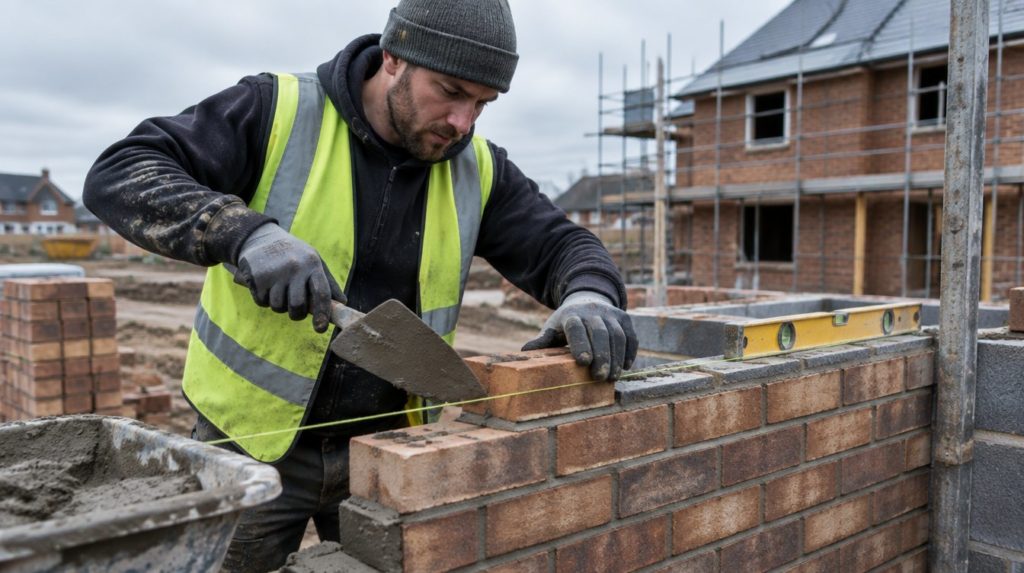
An NVQ in bricklaying is not a course. Nobody teaches you to lay bricks, because you already can. It is an assessment of the work you do every week, carried out on your own sites by an assessor who comes to you, and it ends in a qualification and a CSCS card.
The awarding body calls it Trowel Occupations, which is why you will see that on the certificate. Everybody else calls it a bricklaying NVQ, and it is the same thing.
Two levels matter. Level 2 is the working bricklayer's standard and gets you the Blue Skilled Worker card. Level 3 covers the complex end of the trade, decorative and reinforced work, and gets you the Gold Advanced Craft card. You do not have to do Level 2 first.
- No college, no classroom and no written exam
- Assessed on the walls you are already building
- Start any week, and fast track if you are time served
- Leads to the Blue or Gold CSCS card
- Awarded by GQA, Ofqual regulated
Start here
Which level do you need?
Neither level is a prerequisite for the other. If the work you do already is Level 3 work, you go in at Level 3. The two minute check on any of these pages will tell you which one your day job evidences.
Level 2, the working bricklayer
Blue CSCS Skilled Worker card
You lay bricks and blocks for a living: cavity walls, drainage, setting out, thin joint. This is the standard the industry means when it says a bricklayer is qualified.
Level 3, the complex end
Gold CSCS Advanced Craft card
Decorative brickwork, reinforced and complex masonry, setting out difficult work and putting right other people's mistakes. If that is your week, go in here rather than at Level 2.
The list
The qualifications in this trade
Prices shown are the whole qualification. Level 2 and Level 3 are separate qualifications, not stages.
Method of assessment
How the on-site assessment works
Five steps, and four of them happen on your own jobs.
The online check
Two minutes on this site. It asks what you do, how long you have done it and what evidence you can lay hands on, and tells you which level fits. That check is the initial assessment: there is no separate interview to sit through afterwards.
Register and meet your assessor
You are registered with the awarding body and given one named assessor who stays with you from start to finish. They ring you first, before anything else, to agree the units and work out what you already have that counts.
They come to you
Your assessor visits you on your own jobs, in your own working week. They watch you work, take photographs, ask you why you did it that way and record it against the units. Nothing is staged and nothing is done in a workshop.
Evidence in between
Job records, photographs, drawings, a witness statement from your supervisor. You upload it as you go and your assessor tells you exactly what is still missing, so you are never guessing.
Certificate, then the card
Once the evidence is complete it goes for verification and the certificate is issued. The CSCS card is a separate application to CSCS, with their own fee, and you need a current CITB Health, Safety and Environment test pass to go with it.
For employers
Putting a squad through
Most of this work is done for employers rather than individuals, because it is cheaper and far less disruptive that way round.
- One assessor covers the whole squad, so there is one person to deal with
- Everyone stays on the job. No day-release, no travelling, no lost production
- Different trades and different levels can run alongside each other
- One invoice, and we will tell you where every candidate has got to
- CITB Health, Safety and Environment tests booked in the same block
- CITB grant support where your company is registered and in scope
Bricklaying NVQs: common questions
£850 + VAT for the Level 2, and £950 + VAT for the Level 3. That is the whole qualification: registration with the awarding body, your own assessor, the visits, the portfolio and the certificate. There is no course fee on top because there is no course to attend, and no exam fee because there is no exam. The CSCS card is applied for separately and CSCS charge their own fee for it.
Level 2 is the working bricklaying standard and it leads to the Blue Skilled Worker card. Level 3 is for the more complex end of the trade and leads to the Gold Advanced Craft card. Neither is a prerequisite for the other: if you are already doing Level 3 work you go straight in at Level 3 rather than working up. The check on this site takes two minutes and will tell you which one your day job actually evidences.
No, and there is no written exam either. The assessment happens on your own jobs, during your own working week, with your assessor coming to you. That is the whole point of an NVQ: it measures what you already do rather than teaching you something you already know.
Yes, and for a time-served bricklaying that is the normal route. There is no fixed length, because the pace is set by how quickly the evidence comes together rather than by a timetable. Somebody who already has photographs, job records and a supervisor willing to sign a witness statement often finishes inside a few weeks. Nobody waits for a term to start.
Level 2 leads to the Blue CSCS Skilled Worker card and Level 3 to the Gold CSCS Advanced Craft card. Gold is the advanced craft card, not a supervisor's card: supervising is a different qualification again. Both need a current pass on the CITB Health, Safety and Environment test, taken within the two years before you apply, and the card application goes to CSCS rather than to us.
Because that is the awarding body's name for it. The qualification is the Level 2 or Level 3 NVQ Diploma in Trowel Occupations (Construction), and bricklaying is the pathway within it. Employers, CSCS and the industry all read it as a bricklaying NVQ, and it is the qualification CSCS want to see for a bricklayer's card. Nothing is lost by it being called something else on the paperwork.
The work itself, mostly. Your assessor photographs walls you have built, watches you set out and lay, and records it against the units. Around that: job records, drawings or setting-out details, a witness statement from your supervisor or site manager, and anything you already hold, such as a CITB test pass or a previous certificate. If you have photographs of past work on your phone, bring them; a lot of people are further along than they think.
From the blog
Course guides and news
The latest plain-English guides to choosing the right course, card or qualification.