
 &
& 

Infection Prevention and Control eLearning
Online infection prevention and control training: hand hygiene, PPE, cleaning and waste, and the standard precautions that apply to everyone regardless of setting.
Who it is for
Who this infection prevention and control course is for
Infection control is not only a hospital discipline. Care homes, schools, salons, gyms, food businesses and offices all need it, and the basics are the same everywhere: hands, surfaces, waste and knowing when to stay away.
- Care and healthcare support staff
- Cleaning and domestic teams
- School and childcare staff
- Salon, gym and leisure staff
- Food businesses and catering teams
- Facilities and premises managers
Course content
What the infection prevention and control course covers
Eight short modules on how infection spreads and the standard precautions that interrupt it.
How infection spreads
The chain of infection, and the points where it can be broken.
Standard precautions
The measures applied to everyone, regardless of known infection status.
Hand hygiene
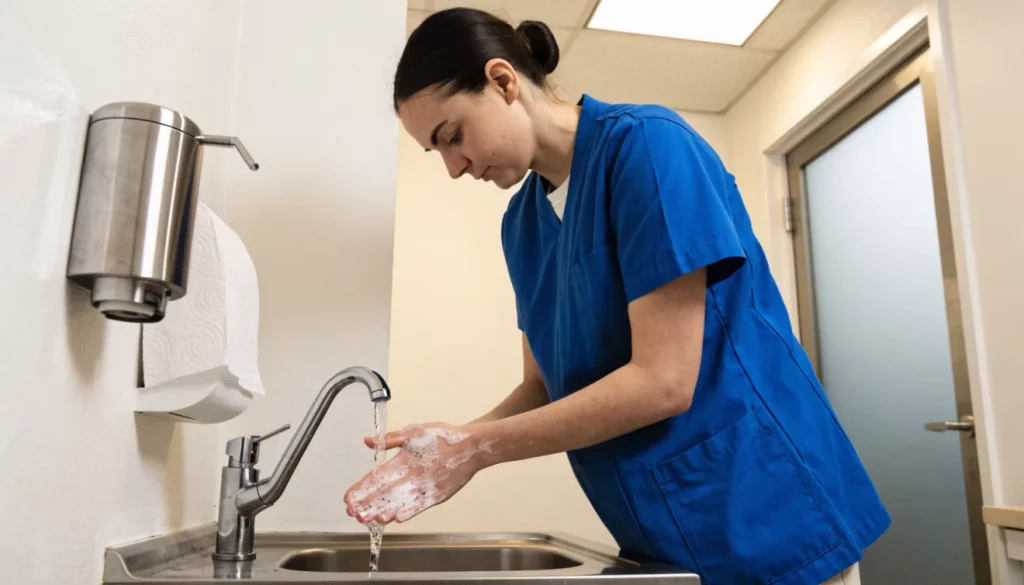
When and how to wash and sanitise, and why technique matters more than frequency.
Personal protective equipment
Gloves, aprons and masks: choosing, wearing and removing them correctly.
Cleaning and disinfection
Surfaces, equipment, frequency and the difference between clean and disinfected.
Waste and laundry
Segregation, handling and safe disposal.
Sharps and spillages
Safe handling, and dealing with blood and body fluid spills.
Outbreaks and reporting
Recognising a pattern, reporting it and what usually follows
Outcomes
What you will be able to do afterwards
- Explain how infection spreads and where the chain can be broken
- Apply standard precautions to everyone
- Wash and sanitise hands with correct technique
- Select, wear and remove PPE in the right order
- Clean and disinfect surfaces and equipment effectively
- Segregate and dispose of waste safely
- Deal with a spillage and report a possible outbreak
Your legal duty
The law behind infection prevention and control training
Infection control has no single regulation of its own in a general workplace. The duties come from health and safety law: the Health and Safety at Work etc. Act 1974, the requirement to assess risk under the Management Regulations 1999, and COSHH, which covers biological agents as substances hazardous to health.
Regulated settings carry more specific requirements. Health and social care providers are subject to their own regulatory standards on infection prevention, and food businesses to food hygiene law. Your own sector regulator is the reference point for those.
- Control of Substances Hazardous to Health Regulations 2002 - biological agents
- Health and Safety at Work etc. Act 1974 - sections 2 and 3
- Management of Health and Safety at Work Regulations 1999 - risk assessment
- Regulated health, care and food settings carry additional sector requirements
Practicalities
How the course works
For employers
Infection Prevention and Control training for a team
Infection control depends on everybody doing the basics consistently, which makes it a whole-team course rather than a specialist one.
- One invoice instead of a card payment per person
- Licences allocated as people join, so induction is covered
- Completion and expiry reporting for your records
- Renewal reminders before certificates lapse
- Bespoke versions built around your own procedures
COSHH covers biological agents alongside chemical hazards. See the COSHH course →
Infection Prevention and Control eLearning: common questions
It covers the standard precautions that apply in any setting. Regulated health and care providers have additional sector requirements that sit on top of this.
They serve different purposes and the course covers when each is appropriate. Alcohol gel is not effective against everything, which is why washing still matters.
Yes, and it matters. Removing PPE incorrectly is one of the most common ways people contaminate themselves after doing everything else right.
The sequence that has to be complete for infection to spread. The course uses it as the framework, because every control measure is really about breaking one link.
Yes, including safe handling and what to do after a sharps injury.
About 30 minutes, with no time limit. Start it, pause it, and come back whenever suits. The certificate is issued the moment you finish.
Yes. It runs in a browser on any modern phone, tablet or computer, with nothing to install.
Yes. Open a business account and we invoice you for the licences, which you allocate as people need them. Completion reporting included.
Related