&
& 


Most advice about looking after your mental health is either too vague to act on or so demanding that it becomes another thing to feel behind on. What follows is the shorter version: things with reasonable evidence behind them, written so you could start one of them today.
None of this replaces proper help. If things are hard right now, skip to the support numbers at the bottom.
Get outside, and notice it
Time in green space is one of the better supported things you can do for your mood, and the effect does not require a national park. A different route to work, ten minutes in a park at lunch, a window seat with something growing outside it.
The noticing part seems to matter as much as the being there. Paying attention to one specific thing, the weather, a bird, the light, does more than walking the same route while scrolling.
Name what you are feeling
Being able to put a word to a feeling reliably reduces its intensity. “I am anxious about Thursday” is easier to do something with than a general sense that everything is wrong.
You do not have to journal for an hour. Two lines at the end of the day, or one sentence in your phone, is enough to start noticing patterns.
Talk to yourself the way you would talk to a colleague
Most of us say things to ourselves we would never say to somebody we work with. If you catch yourself at it, the useful question is: would I say that out loud to somebody I respected? If not, it is probably not accurate either.
Tell somebody
Saying a thing out loud changes it. Partly because the person listening may see it differently, and partly because describing something forces you to make it specific.
It does not have to be a professional and it does not have to be a big conversation. A friend, a colleague you trust, a family member. If you would rather not talk to anybody you know, Samaritans exist for exactly that.
Watch what you are using to cope
Alcohol and drugs work in the short term, which is the problem. They reliably make anxiety and low mood worse over weeks and months, and they make sleep worse almost immediately even when they help you get to sleep.
Worth being honest with yourself about whether a drink at the end of the day is a pleasure or a management strategy. If it is the second, your GP will have heard it many times before and will not be shocked.
Deal with money worries as a health issue
Debt and mental health run in both directions: worry makes it harder to deal with the money, and the money makes the worry worse. Free, confidential advice exists and it is genuinely good. StepChange, National Debtline and Citizens Advice will all talk to you without charging you.
If your employer has an employee assistance programme, financial advice is very often part of it and most people never find out.
Protect your sleep
Sleep is upstream of almost everything else here, and it is the first thing to go when you are struggling.
- Roughly the same wake up time every day, weekends included, does more than the bedtime
- Screens down before bed, and the phone charging somewhere other than beside your head
- Caffeine has a long tail. Afternoon coffee is still working at midnight for a lot of people
- If you cannot sleep, get up rather than lying there. Lying awake in bed teaches your brain that bed is where you lie awake
- Shift workers need a different plan, and one that accounts for the drive home
Do something for somebody else
Small acts of help reliably lift mood, and they do it partly by giving you a sense of being useful. It does not need to be organised. Making somebody a brew, covering a job, taking five minutes to properly answer a new starter’s question.
Keep moving
Physical activity has one of the strongest evidence bases in this whole list, and the useful threshold is lower than people think. A brisk walk counts. Getting off the bus early counts. You do not need a gym membership and you certainly do not need to enjoy running.
Eat and drink like it matters, because it does
Erratic eating makes mood swings worse, and dehydration makes concentration worse. On site and on shift this is largely a planning problem rather than a willpower problem: what you bring with you decides what you eat.
Try something new, and plan something ahead
Novelty and anticipation both do useful work. Something to look forward to, even small and even weeks away, changes how the intervening time feels. And trying something you are not good at is a reliable way to get out of your own head for an hour.
If you manage people
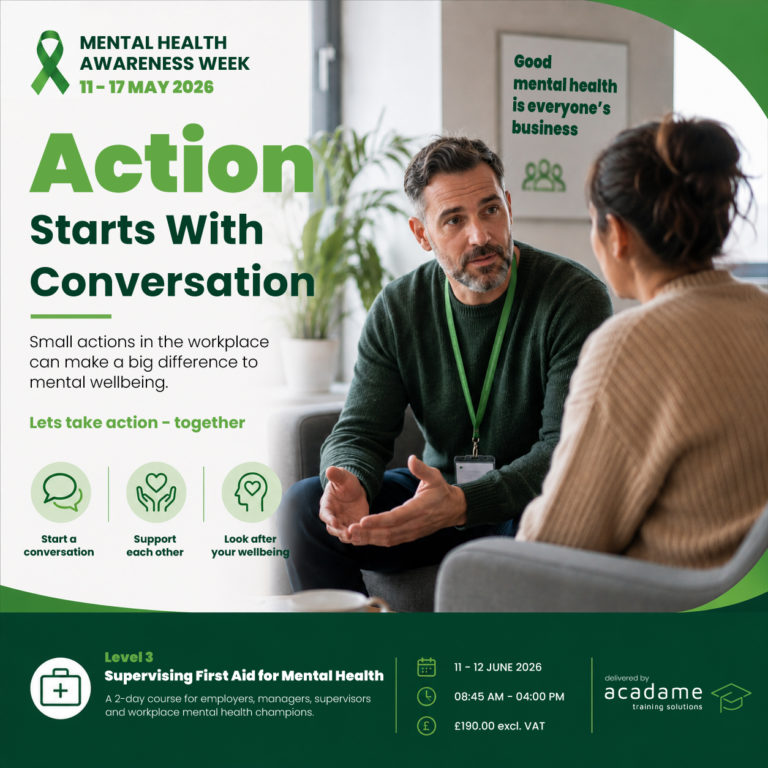
Everything above is individual. If you are responsible for a team, the more useful lever is the work itself: workload, control, support, clarity of role and how change gets handled. Supervising First Aid for Mental Health covers how to spot somebody struggling and how to start the conversation, and stress in the workplace training covers the organisational side.
If you need support now. Samaritans are on 116 123, free, at any hour. Text SHOUT to 85258 for a text conversation. For urgent NHS mental health help, call 111 and select the mental health option. In an emergency, 999. If you are struggling, your GP is a good place to start and is not a fuss.
Find a date that works
Every course, every centre, with live availability and prices.
On your site or ours, and group rates on request.