&

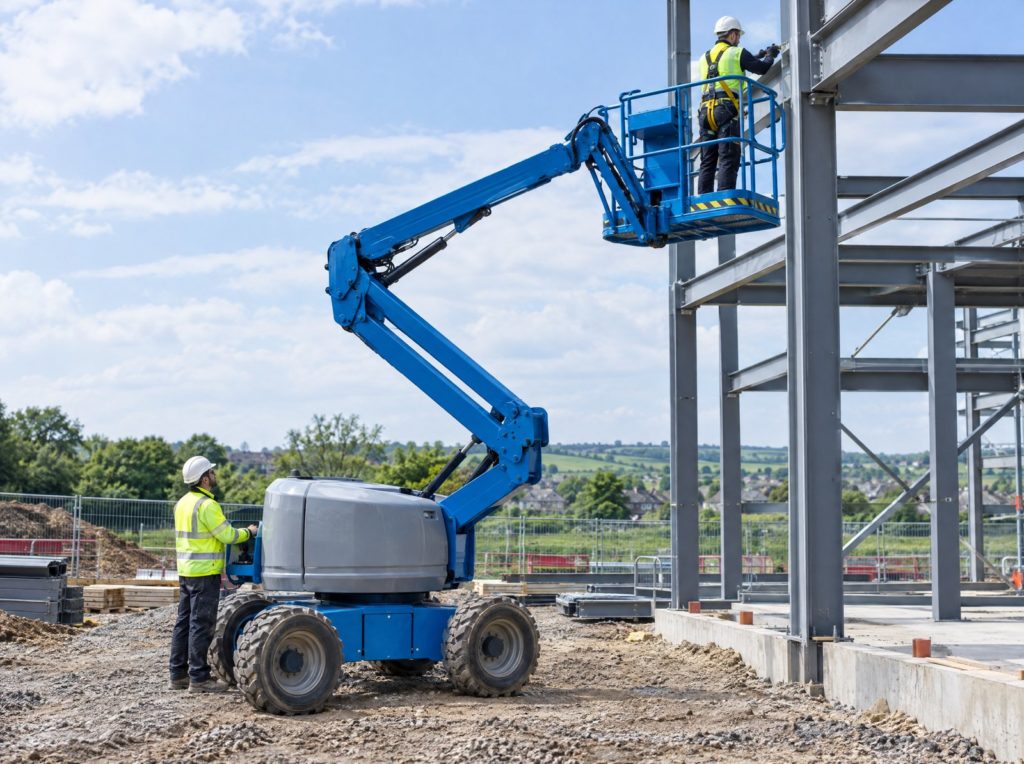
Pick whichever card your client, principal contractor or hire company will accept. IPAF and NPORS both train and test people to operate mobile elevating work platforms (MEWPs) such as cherry pickers and scissor lifts, and both cards can carry the CSCS logo. IPAF is the better known scheme and some clients name it in their rules, so get the requirement in writing before you book.
Two schemes, one job
A MEWP lifts people, so the operator needs proof of training before going up. In the UK that proof usually comes from one of two schemes. IPAF, the International Powered Access Federation, issues the PAL (Powered Access Licence) card. NPORS, the National Plant Operators Registration Scheme, issues an NPORS card with the MEWP categories recorded on it.
| IPAF | NPORS | |
|---|---|---|
| Card | PAL card, widely recognised in the UK and internationally | NPORS card, red Trained Operator or blue Competent Operator |
| MEWP categories | Including 3a mobile vertical (scissor lifts), 3b mobile boom, 1a static vertical and 1b static boom | N108 MEWP Boom and N109 MEWP Scissor |
| CSCS logo | Available on UK cards with a CITB HS&E test passed in the two years before applying | On the NPORS CSCS card, with a CITB or NPORS HS&E test passed in the two years before applying |
Which card will your site accept?
This is the question that really matters. Some principal contractors and hire companies accept either card. Others name IPAF in their own rules, and if yours does, IPAF is what you need: NPORS is not accepted everywhere IPAF is. Ask for the requirement in writing before you book anything, and you will not pay for the wrong card.
Boom or scissor: why they are separate
Scissor lifts rise straight up with full edge protection. Boom lifts reach out on an arm that can swing and whip, and a major danger is entrapment: being crushed between the platform and a structure. IPAF technical guidance strongly recommends that people in a boom wear a full body harness with a lanyard short enough to restrain them within the platform. In a scissor lift a harness is not normally required, and HSE guidance takes the same line, other than in exceptional circumstances. That is why each machine type is its own category and its own test, and why NPORS Harness and Fall Arrest training is worth considering for boom operators.
What the NPORS route looks like
- Courses: NPORS MEWP Boom (N108) and NPORS MEWP Scissor (N109).
- Length: one day for a novice in each category, with shorter routes for operators who already do the work and can show it.
- Group size: NPORS allows up to four candidates with one instructor and one machine; the experienced worker test allows six.
- Where: on your site and your own machine, or at a venue near you.
- Test: an NPORS theory test and a practical test, both with us as an NPORS test centre.
- Card: a red Trained Operator card, valid for two years while the operator registers for and completes the NVQ, or a blue Competent Operator card, valid for five years, once the NVQ is held.
For the person planning and supervising powered access work rather than operating, NPORS MEWP Supervisor Awareness (N035) is the better fit.
Things no card replaces
Whichever card your operators hold, three things still need to be in place on site:
- Familiarisation on the exact model, because controls and emergency systems differ between machines.
- A rescue plan with someone trained on the ground level emergency controls. Calling the fire service is not a plan, and the Work at Height Regulations 2005 expect emergencies and rescue to be planned for.
- A thorough examination report in date. A MEWP lifts people, so under LOLER it is thoroughly examined at least every six months (or in line with a written examination scheme), rather than the twelve months that applies to most other lifting equipment.
Getting the CSCS logo on the card
Both schemes can put the CSCS logo on a UK card. NPORS asks for a CITB or NPORS Health, Safety and Environment test passed within the two years before the card application; IPAF asks for a CITB test passed in the same two year window. We are a CITB test centre, so you can book your HS&E test with us and line it up with the training.
Frequently asked questions
Is NPORS accepted instead of IPAF?
Often, but not always. Some sites and hire companies accept either card, but others name IPAF in their rules, and if yours does, book IPAF. Ask for the requirement in writing first.
How long is NPORS MEWP training?
One day for a novice in each category (N108 boom or N109 scissor), with shorter routes for experienced operators.
Do you need a harness in a scissor lift?
Not normally. IPAF guidance strongly recommends a full body harness with a short restraint lanyard in boom lifts, and IPAF and HSE guidance both say fall protection is not normally needed in a scissor lift other than in exceptional circumstances.
Does the card cover every machine?
No. The category covers the machine type, but operators still need familiarisation on the specific model before using it.
Read the source
Sources: NPORS training and testing ratios and card information, IPAF MEWP categories, FAQs and technical guidance H1 on fall protection in MEWPs, HSE guidance on fall protection in MEWPs, regulation 9 of the Lifting Operations and Lifting Equipment Regulations 1998 on legislation.gov.uk, and Acadame’s NPORS N108 and N109 course pages. Facts checked on 9 November 2026.
Build your NPORS course
Tell it who is coming and it works out the days, the ratio and how many times it has to run.
Your site or ours. Quoted per group, not per head.