
 &
& 

Manual Handling eLearning
The online course that teaches your people to assess a load before they lift it, and gives you the training record the Manual Handling Operations Regulations expect you to hold.
Who it is for
Who this manual handling course is for
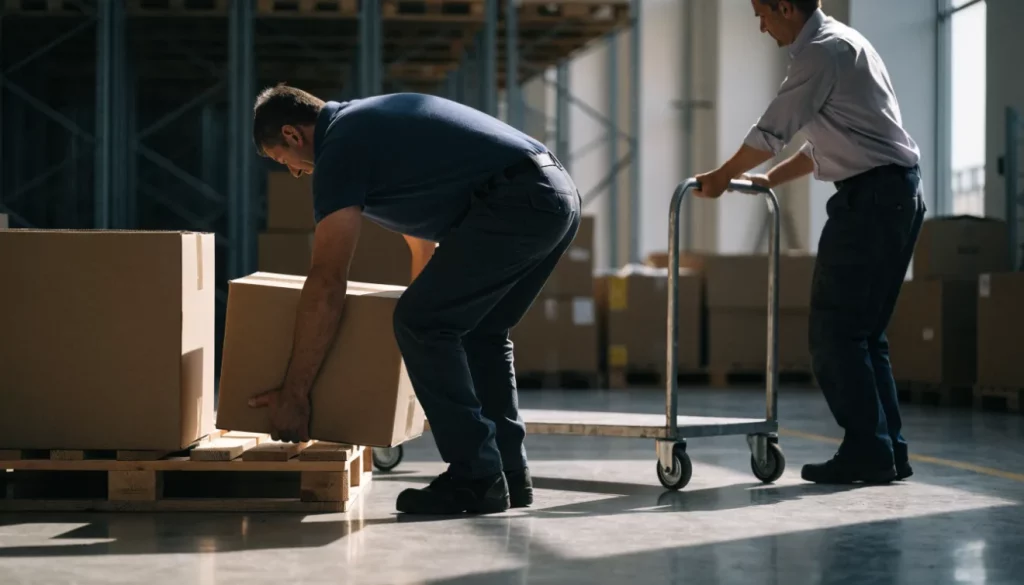
Handling injuries are the single most common cause of workplace absence in the UK, and they are rarely caused by one dramatic lift. This course is written for anyone whose job involves lifting, lowering, pushing, pulling or carrying: which, in most workplaces, is nearly everyone.
- Warehouse, stores, delivery and logistics staff
- Construction and site operatives handling materials by hand
- Care and healthcare workers moving equipment and supplies
- Retail and hospitality staff handling stock and deliveries
- Office staff who move boxes, files or IT equipment
- Supervisors and managers writing or reviewing a manual handling risk assessment
Course content
What the manual handling course covers
Five short lessons, then a 12-question assessment. The course is built around TILE (Task, Individual, Load, Environment), because a lift is judged before it is made, not halfway through it.
Why this matters
What manual handling actually means, the injury picture from HSE's statistics, and the law in one page: what your employer must do and what you must do.
Spotting the risk: TILE
Task, Individual, Load and Environment, testing a load before you commit, and the guideline weights as a filter rather than a limit.
Before you lift: avoid, then reduce
Whether the lift can be avoided, using and checking handling aids, team handling, and pushing and pulling.
Good handling technique
The basic two-handed lift as HSE sets it out: plan, lift, move and place, then lowering and putting down.
Your part in it, and the assessment
Following the system of work, when to stop and ask, speaking up early about symptoms and faulty aids, and the end assessment.
Outcomes
What you will be able to do afterwards
- Explain what counts as manual handling and the duties on you and your employer
- Assess a handling task using TILE before you start
- Avoid or reduce a lift using handling aids and team handling
- Use good handling technique to lift, move and put down a load
- Know when to stop, ask and report a problem
Your legal duty
The law behind manual handling training
Manual handling training is not optional where there is a risk of injury. The Manual Handling Operations Regulations 1992 require employers to avoid hazardous manual handling so far as is reasonably practicable, assess the operations that cannot be avoided, and reduce the risk of injury to the lowest level reasonably practicable.
Training on its own does not discharge that duty. You still need the assessment and the practical controls, but an untrained workforce makes the duty impossible to meet, and a missing training record is the first thing an inspector or a claimant's solicitor asks about.
- Manual Handling Operations Regulations 1992 (as amended)
- Health and Safety at Work etc. Act 1974 - sections 2 and 7
- Management of Health and Safety at Work Regulations 1999 - risk assessment and training
- HSE guidance L23, Manual handling at work
Practicalities
How the course works
Would you rather have a tutor?
Where people need to practise the lift with the loads they actually handle, and be watched doing it, the classroom session is the one that does that. The online module cannot.
For employers
Buying manual handling training for a team
Above a couple of people, an account is easier than card payments. One invoice, licences you allocate as staff join, and a report of who has completed what and when it runs out.
- One invoice instead of a card payment per person
- Licences allocated as people join, not bought again each time
- Completion and expiry reporting for your health and safety file
- Renewal reminders before certificates lapse
- Bespoke versions written around your own loads, aids and procedures
Manual Handling eLearning: common questions
It covers the awareness and technique element the Regulations expect, and gives you a dated training record for each person. It does not replace your manual handling risk assessment, or the practical supervised training people need where the handling is genuinely high-risk.
The online course takes 30 to 45 minutes and teaches anyone to assess a load before they lift it. It is the right answer for a whole workforce who occasionally lift a box. The half day classroom session has people handling real loads and being corrected while they do it, and that is what you want where lifting is the job rather than an occasional part of it.
About 30 to 45 minutes. There is no time limit: start it, pause it, and come back whenever suits. The certificate is issued as soon as you pass the end assessment.
Three years is the usual refresher interval for manual handling awareness. Sooner if the job, the loads or the equipment change materially.
Yes. It runs in a browser on any modern phone, tablet or computer, with nothing to install.
Yes. It names the learner, the course, the completion date and Acadame as the provider, which is what is asked for at awareness level.
Yes. Open a business account and we invoice you for the licences, which you then allocate as people need them, with completion reporting included.
Load, Individual, Task, Environment: the four things to weigh up before making a lift. It is the framework the course teaches you to apply to any handling task.
Related