&
& 

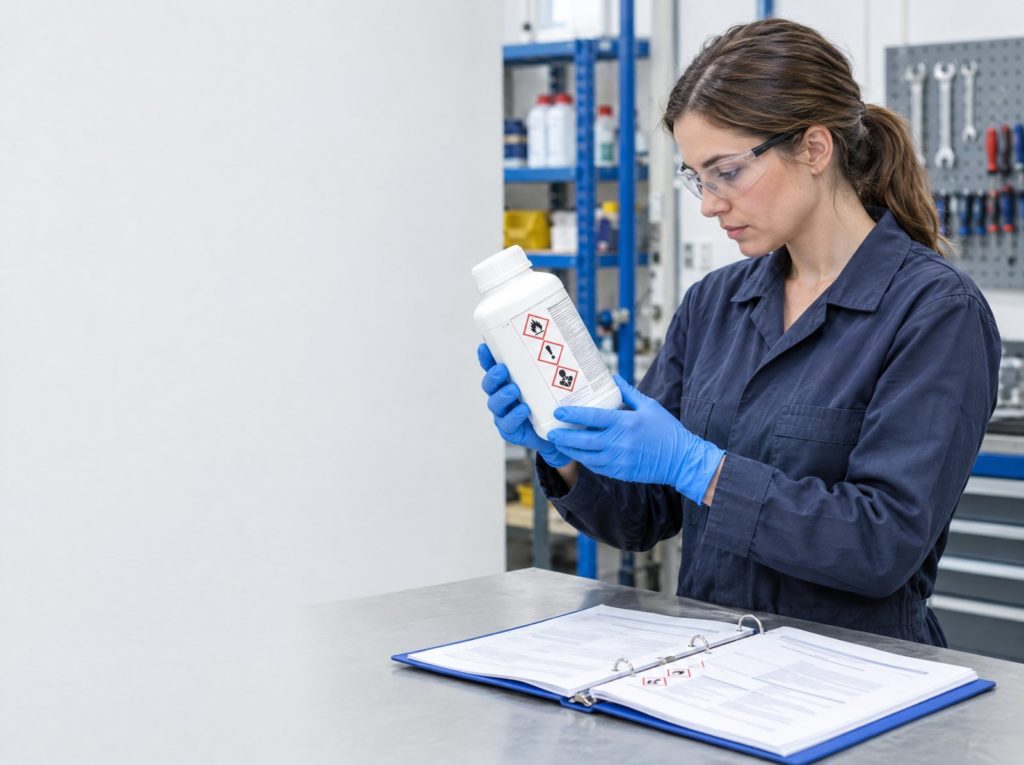
COSHH stands for the Control of Substances Hazardous to Health Regulations 2002. It is the law that requires employers to control substances that can harm workers’ health, from cleaning chemicals to dust and fumes.
What COSHH stands for
Control of Substances Hazardous to Health. The regulations apply to almost every workplace in Great Britain, because almost every workplace uses something hazardous, even if it is only cleaning products.
What counts as a hazardous substance
- Chemicals and products such as cleaners, paints, solvents, adhesives and pesticides
- Fumes, such as welding fume
- Dusts, including wood dust and silica dust from cutting stone, brick and concrete
- Gases and vapours
- Biological agents such as bacteria and viruses
A few hazards have their own separate rules instead, including asbestos, lead and radioactive substances.
How substances harm people
They get into the body four ways: breathing in, skin contact, swallowing and, more rarely, injection through the skin. The harm can be immediate, like a chemical burn, or build up slowly over years, like dermatitis, occupational asthma or lung disease from dust. Most of it is preventable.
What employers must do: the eight steps
- Assess the risks from hazardous substances.
- Decide what precautions are needed.
- Prevent or adequately control exposure.
- Make sure control measures are used and maintained.
- Monitor exposure where needed.
- Carry out health surveillance where needed.
- Prepare plans and procedures for accidents and emergencies.
- Make sure employees are properly informed, trained and supervised.
What a COSHH assessment looks like
A COSHH assessment lists the substances used, who could be exposed and how, and the controls in place. Controls follow the hierarchy of controls: remove or swap the substance first, then enclose it or extract it with local exhaust ventilation, then use safe working methods, and only then rely on personal protective equipment such as gloves and respirators.
Reading labels and safety data sheets
Hazard labels use red diamond pictograms that show at a glance whether a product is, for example, corrosive, flammable or toxic. The safety data sheet from the supplier gives the detail: hazards, safe handling, storage, first aid and what to do if it spills. Workers should know where to find both.
Who needs COSHH training
Anyone who works with or near hazardous substances, and the people who supervise them: cleaners and facilities staff, construction and maintenance workers, manufacturing operatives, laboratory and workshop staff, and catering teams.
| Course | What it is |
|---|---|
| COSHH Awareness | Half a day, at our centres or at your site. Practical work with real labels and data sheets, with a recommended refresh every three years. |
| COSHH Awareness eLearning | Online, on any device. Suits lower-risk roles, new starters and refreshers. |
To understand the red diamond symbols on product labels, see our guide to hazard symbols.
The ACoP and official guidance
| Publication | Status | What it covers |
|---|---|---|
| L5 Control of substances hazardous to health (6th edition, 2013) | ACoP and guidance | Assessment, prevention and control, the principles of good practice, maintenance of controls, monitoring, health surveillance and emergencies. |
| EH40/2005 Workplace exposure limits | Legal list of limits | The workplace exposure limits that apply under COSHH. |
An Approved Code of Practice (ACoP) has special legal status under section 16 of the Health and Safety at Work Act. If you are prosecuted and did not follow it, you must show that you met the law in some other way that was just as good. Guidance on Regulations has no special legal status, but inspectors refer to it and following it is normally enough to comply. Our guide to UK health and safety legislation lists every law and its ACoP or guidance in one place.
Frequently asked questions
What does COSHH stand for?
Control of Substances Hazardous to Health. The full title is the Control of Substances Hazardous to Health Regulations 2002.
Does COSHH apply to small businesses?
Yes. It applies to any employer whose work involves hazardous substances, whatever the size.
Is COSHH training a legal requirement?
Employers must make sure workers are properly informed, trained and supervised on the hazardous substances they work with.
How long is COSHH awareness training?
Our classroom course is half a day.
Read the source
The Control of Substances Hazardous to Health Regulations 2002 (SI 2002/2677), published on legislation.gov.uk, and the Health and Safety Executive’s COSHH guidance. Facts checked on 5 October 2026.
Find a date that works
Every course, every centre, with live availability and prices.
On your site or ours, and group rates on request.