&
& 


There is no single best mental health initiative for a workplace, and anybody selling you one has not asked enough questions about yours. What works in a 40 person office does not transfer to a site team spread across four contracts, and what a young workforce responds to is not what a workforce in its fifties responds to.
What does transfer is the thinking behind it. Below is what we see actually working, roughly in the order we would start.
Start at the top, or do not start
Not an initiative as such, but the thing everything else depends on. If a director or a site manager will say out loud that this matters, and better still say something about their own experience, the temperature in the room changes. If leadership stays silent, a poster campaign reads as a tick box exercise and people treat it as one.
Practical version: get one senior person to open the first session, and ask them to stay for it rather than leave after the introduction.
Train the managers first
Line managers and supervisors deal with this every week. They are usually the first to notice that somebody is not themselves, and they are usually the least equipped to do anything about it. Most of them are frightened of saying the wrong thing, so they say nothing.
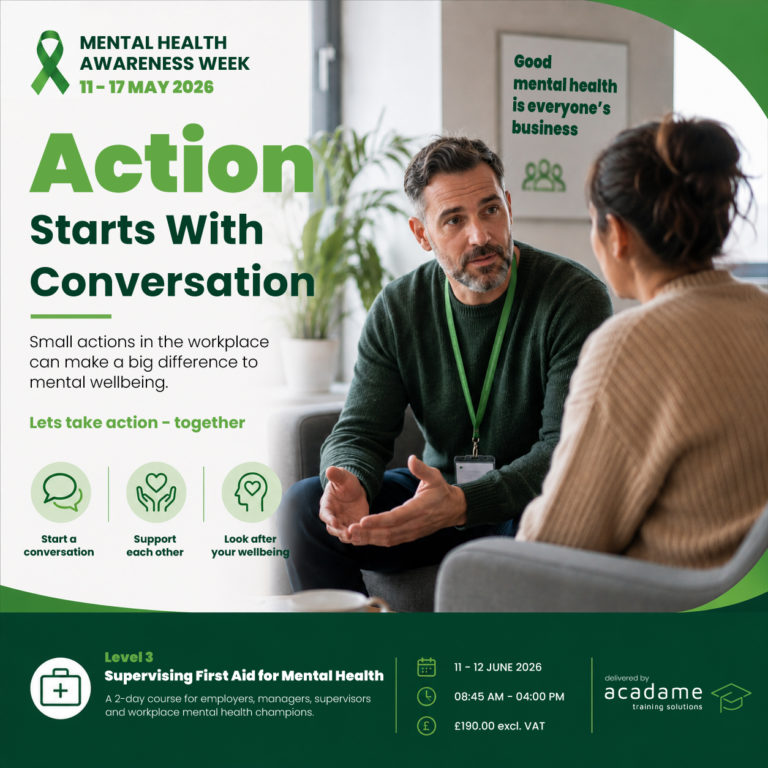
Training them changes that more than any other single spend. Supervising First Aid for Mental Health is the standard two day course for exactly this group: how to spot that somebody is struggling, how to start the conversation, and where the line is between supporting somebody and trying to treat them. For a wider rollout, mental health and wellbeing eLearning covers the awareness end at a lower cost per head.
Make the conversation normal
The single most useful thing a supervisor can do is ask how somebody is, and then wait. Not as a formality at the start of a one to one, but properly, with enough silence afterwards for an honest answer.
Build it in: a standing item on one to ones, a walk rather than a meeting room, a catch up that is not about the job. The goal is that nobody has to make a special occasion out of raising something.
Look at the work, not just the worker
This is the part most programmes skip. Wellbeing initiatives aimed at helping people cope are doing useful work, but if the pressure itself is the problem then resilience training is asking people to absorb something that should have been fixed.
The HSE Management Standards give you six things to look at: demands, control, support, relationships, role and change. They are designed to be assessed the same way you would assess any other risk, and doing so is a legitimate part of a risk assessment. Ask about workload, rota stability, whether people know what is expected of them, and how change gets communicated.
Signpost what you already have
Most organisations have more support in place than their people know about. An employee assistance programme nobody can find the number for is doing nothing. Occupational health that takes a manager referral nobody realises they can make is doing nothing.
- Put the EAP number somewhere people actually look, not only the intranet
- Say what it covers, because most people assume it is counselling only
- Make clear it is confidential, and mean it
- Add the external routes too: Samaritans, Shout, NHS 111 option two, Mind
Use the national campaigns, but add something
Mental Health Awareness Week in May and World Mental Health Day in October come with free materials and give you a reason to talk about it without having to invent one. They work best when you attach something real to them: a session people can book, a change you are announcing, a manager saying something true.
They work worst as a week of posters followed by eleven months of nothing.
Flexibility, movement and connection
Three that consistently come up and cost relatively little.
- Flexibility. Where the work allows it, giving people some control over when and where they work helps more than most formal programmes. Control is one of the HSE standards for a reason.
- Movement. Walking meetings, a lunchtime walk, a team entry into a charity event. Physical activity has one of the better evidence bases behind it.
- Connection. Lunch and learns, a team day, anything that gives people a reason to talk to somebody they would not otherwise talk to. Isolation is a risk factor, and it is worse for lone workers and for people on nights.
Specific groups, specific support
A general programme will miss some people. Worth looking at separately: lone and night workers, new starters, people returning after a long absence, anybody going through the menopause, and in construction, the well documented risk among site based men. Targeted beats generic.
Review it, and expect it to change
People join and leave, the business gets busier and quieter, and what was needed in January is not what is needed in September. Set a point to look at it again, ask people what they actually used, and be willing to stop something that is not landing.
And say when something has worked. Programmes die quietly because nobody ever heard that they made a difference.
If you need support now. Samaritans are on 116 123, free, at any hour. Text SHOUT to 85258 for a text conversation. For urgent NHS mental health help, call 111 and select the mental health option. In an emergency, 999. If you are struggling, your GP is a good place to start and is not a fuss.
If you want help building this into your wider health and safety arrangements rather than running it alongside them, our consultancy team can do that with you.
Find a date that works
Every course, every centre, with live availability and prices.
On your site or ours, and group rates on request.