&
& 

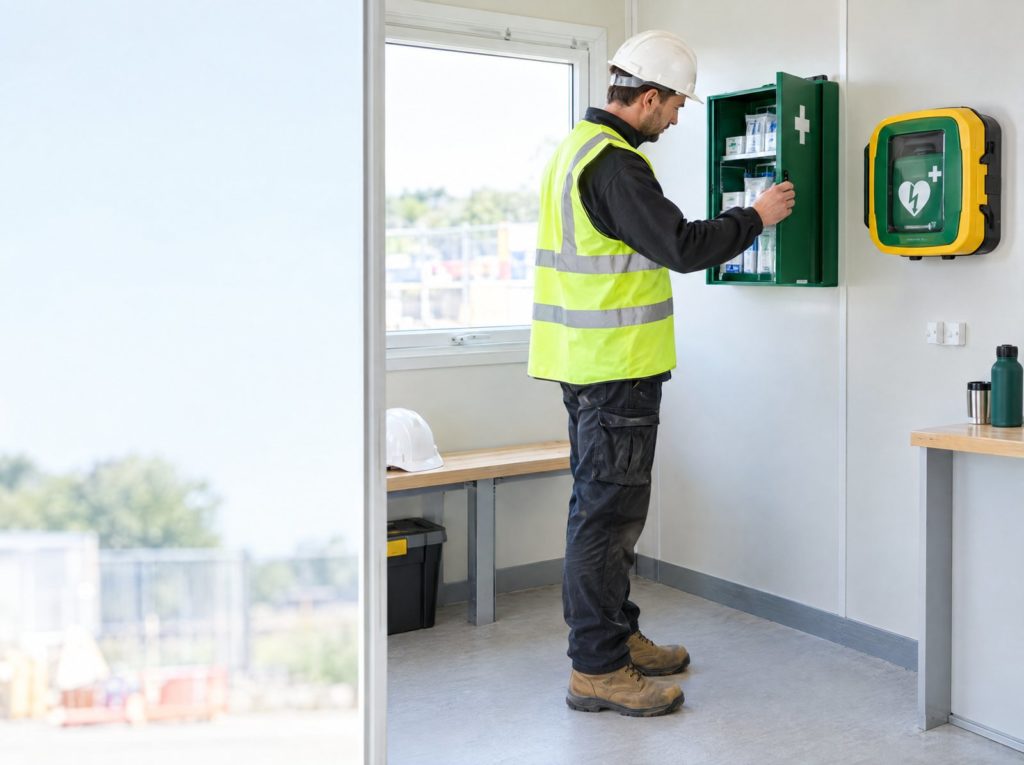
The Health and Safety (First-Aid) Regulations 1981 require employers to provide adequate and appropriate first aid equipment, facilities and people. What counts as adequate depends on your workplace, which is why the starting point is a first aid needs assessment.
What to consider in a needs assessment
- The hazards and risks in your work, such as machinery, work at height or hazardous substances
- How many people work for you, and how they are spread across sites and shifts
- Your history of accidents and ill health
- Lone workers, travelling workers and people working at remote sites
- How far you are from emergency services and how long they take to arrive
- Cover for holidays, sickness and shift patterns
- Workers with known health conditions or disabilities
- Visitors and members of the public, which HSE strongly recommends including
How many first aiders? HSE’s suggested numbers
HSE guidance L74 gives a starting point. Your needs assessment may show you need more.
| Hazard level | Number of employees | Suggested first aid cover |
|---|---|---|
| Lower hazard, such as offices and shops | Fewer than 25 | At least one appointed person |
| Lower hazard | 25 to 50 | At least one first aider trained in EFAW |
| Lower hazard | More than 50 | At least one first aider trained in FAW for every 100 employees |
| Higher hazard, such as construction, manufacturing and work with dangerous machinery | Fewer than 5 | At least one appointed person |
| Higher hazard | 5 to 50 | At least one first aider trained in EFAW or FAW, depending on the type of injuries that might occur |
| Higher hazard | More than 50 | At least one first aider trained in FAW for every 50 employees |
FAW, EFAW or appointed person?
| Role | Training | Suited to |
|---|---|---|
| Appointed person | No formal qualification required, though short training is useful | Taking charge of first aid arrangements and calling the emergency services in low-risk, small workplaces |
| Emergency First Aid at Work (EFAW) | One day course | Lower risk workplaces and smaller higher risk teams |
| First Aid at Work (FAW) | Three day course | Higher risk workplaces, larger teams and remote sites |
FAW and EFAW certificates last three years. HSE strongly recommends annual refresher training to keep skills current between requalifications.
First aid kits and equipment
There is no legal list of contents. The contents should reflect your needs assessment, and many employers use kits that meet British Standard BS 8599-1. On construction sites, consider eye wash where dust or chemicals are a risk, burns dressings, and catastrophic bleed kits where there is a risk of serious cuts. Defibrillators are not a legal requirement, but many sites and workplaces now have one.
First aid on construction sites
- On sites with several contractors, the principal contractor usually coordinates first aid cover so that every team is covered.
- Plan cover for every shift and every work area, including remote parts of large sites.
- Display who the first aiders are and where the kits are, and include this in inductions.
- Make sure someone knows how to direct the emergency services to the site entrance and the casualty.
Training that helps
We run the QNUK First Aid at Work three day course, the one day Emergency First Aid at Work course and the FAW requalification course, plus an annual first aid refresher. For higher-risk sites, see our catastrophic bleeding first aid course, and for people who work alone, our lone working first aid course.
Where this fits in SMSTS and SSSTS
First aid provision and planning for remote or high-risk sites are tested on both papers. Our free SMSTS mock test and SSSTS mock test let you check your knowledge before the course or a refresher, and you can email yourself the results sheet at the end.
When you are ready, the five day SMSTS course is for site managers and the two day SSSTS course is for supervisors. If your certificate is due, the SMSTS refresher and SSSTS refresher keep it current.
Frequently asked questions
Is a first aid needs assessment a legal requirement?
The law requires adequate and appropriate first aid. A needs assessment is how employers work out what that means for them, and HSE expects one.
How many first aiders do I need on a construction site?
HSE suggests at least one EFAW or FAW trained first aider for 5 to 50 workers in higher hazard work, and one FAW first aider for every 50 above that, adjusted for your own risks.
How long does a first aid certificate last?
Three years for FAW and EFAW. HSE strongly recommends annual refresher training.
Is a defibrillator a legal requirement?
No, but many employers provide one, and it can make a life-saving difference while waiting for an ambulance.
Read the source
The Health and Safety (First-Aid) Regulations 1981; HSE guidance L74, First aid at work, including its table of suggested numbers of first aid personnel; HSE leaflet INDG214, First aid at work: your questions answered; and BS 8599-1, Workplace first aid kits. Facts checked on 6 October 2026.
Find a date that works
Every course, every centre, with live availability and prices.
On your site or ours, and group rates on request.