&


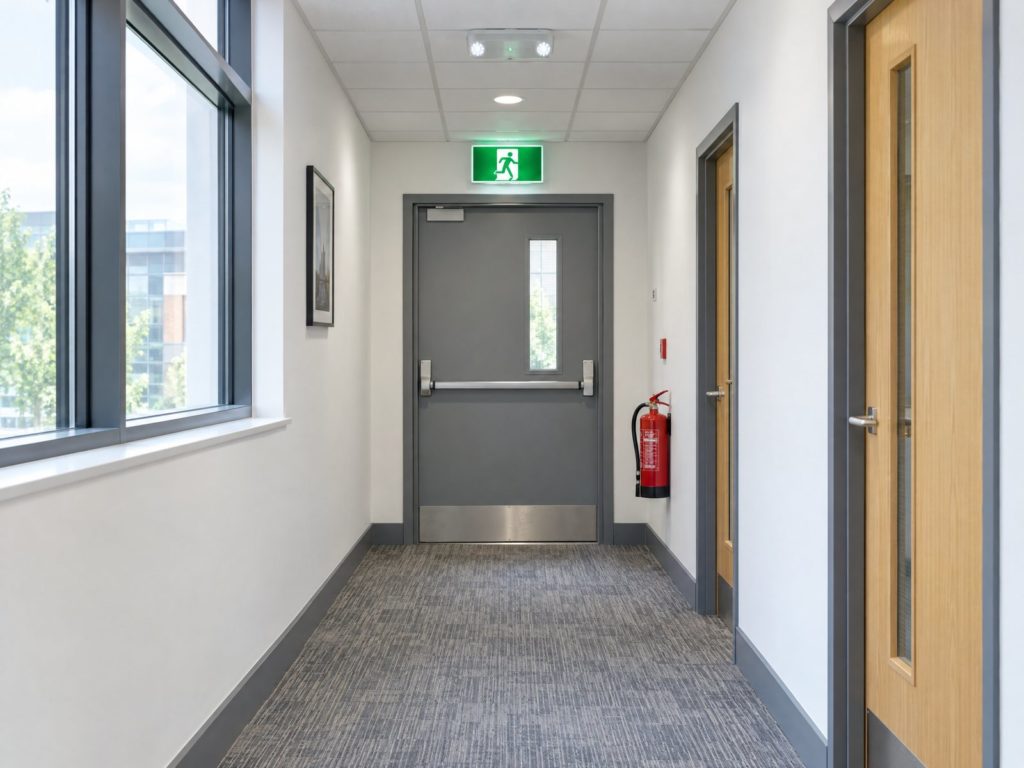
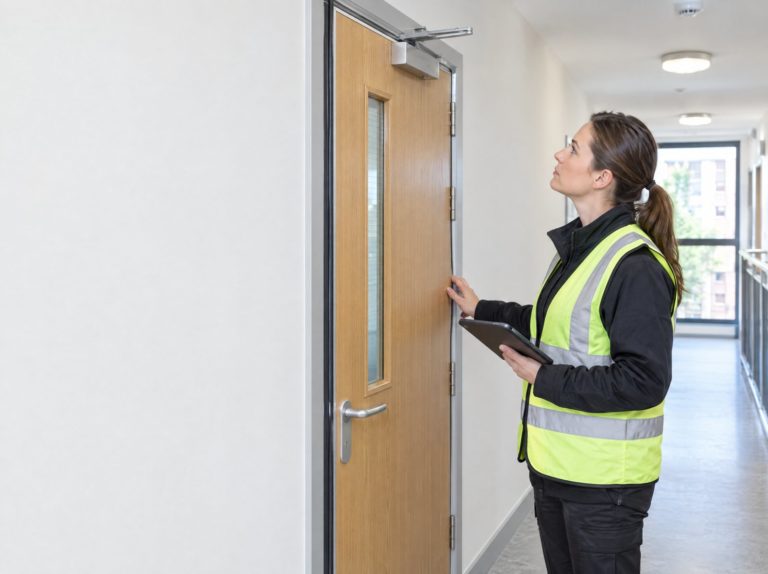
In England and Wales, the Regulatory Reform (Fire Safety) Order 2005 requires fire exits and the routes to them to be kept clear at all times, to lead as directly as possible to a place of safety, to open easily in the direction of escape and to be signed and, where needed, lit. The responsible person for the premises, usually the employer, must make sure that is true every day, not just on inspection day.
What the law requires
Article 14 of the Fire Safety Order sets out the rules for emergency routes and exits. They apply where necessary to keep people safe, which your fire risk assessment decides. In short:
- Routes to emergency exits, and the exits themselves, must be kept clear at all times.
- Emergency routes and exits must lead as directly as possible to a place of safety.
- In the event of danger, people must be able to evacuate as quickly and as safely as possible.
- The number, distribution and size of routes and exits must be adequate for the use of the premises and the maximum number of people who may be there.
- Emergency doors must open in the direction of escape.
- Sliding or revolving doors must not be used for exits specifically intended as emergency exits.
- Emergency doors must not be locked or fastened so that anyone who needs them in an emergency cannot open them easily and immediately.
- Emergency routes and exits must be indicated by signs.
- Routes and exits that need lighting must have emergency lighting of adequate intensity in case the normal lighting fails.
How many exits you need, how wide they must be and how far people can travel all come from your fire risk assessment, which article 9 requires to be suitable and sufficient. Article 17 adds that exits, doors, signs and emergency lighting must be maintained in efficient working order and good repair.
Fire exit doors and fire doors are not the same
| Door | What it does |
|---|---|
| Fire exit door | A door you leave through in an emergency. It must open easily and immediately, in the direction of escape, without a key or code. |
| Fire door | A fire-resisting door inside the building that holds back fire and smoke. It is normally self-closing and must not be wedged open, because a wedged door lets fire and smoke spread. |
Push bars and push pads are common on exit doors because they open in one movement. Government fire safety guidance says premises used by members of the public, or by others unfamiliar with the building, should normally use panic exit devices (push bars or touch bars, to BS EN 1125). Where only a limited number of staff who know the building use the exit, and panic is unlikely, emergency exit devices such as push pads or lever handles (to BS EN 179) may be used instead.
Fire exit signs
Escape route signs fall under the Health and Safety (Safety Signs and Signals) Regulations 1996. These require emergency escape signs to be rectangular or square, with a white pictogram on a green background, the green taking up at least half the sign. A sign that uses only text does not comply. Most signs today use the green running-man pictogram from BS EN ISO 7010, which HSE covers in its guidance on the Regulations. See our guide to safety signs and colours for how escape signs fit alongside the other types.
Signs must be visible from along the route and point the right way. The Regulations say signs that need power must have a guaranteed emergency supply, and government guidance says emergency lighting should cover exit doors and escape signs so they can still be seen if the lights fail. A “Fire escape, keep clear” notice on the outside of exit doors that are not used day to day stops deliveries and bins being left against them.
The commonest fire exit failures
- Stock, pallets or bins blocking the route or the outside of the door
- Doors locked, bolted or chained for security while people are still inside
- Fire doors wedged open on the route
- Signs missing, hidden behind displays or pointing the wrong way
- Emergency lighting not tested
A weekly check for fire wardens
- Walk every escape route to the final exit and out to the assembly point.
- Open every exit door: it should open in one movement, without a key.
- Check the outside of each exit is clear.
- Check fire doors on the route close fully on their own.
- Look for missing or hidden signs, and report emergency lighting faults.
- Write down what you found and who is fixing it.
Government guidance also suggests a daily look for bolts, padlocks and obstructions on exits, a monthly emergency lighting test and an annual test by a competent person, so build the weekly walk into that wider routine.
Remember people who need help to leave. Anyone who would struggle to use the exits unaided should have a personal emergency evacuation plan (PEEP).
Who should be trained
Fire wardens and marshals (is there a difference?) do this checking week to week. Our Fire Warden (Marshal) course is half a day, run at our Stoke-on-Trent, Derby, Manchester and Liverpool centres or onsite at your premises. For the person who owns fire safety and writes the fire risk assessment, the NEBOSH Certificate in Fire Safety is the Level 3 qualification.
Frequently asked questions
Is it illegal to block a fire exit?
Yes, where the exit is needed for people’s safety. Article 14 of the Fire Safety Order requires routes to emergency exits, and the exits themselves, to be kept clear at all times. The fire and rescue authority can serve an enforcement notice, and a failure that puts people at risk of death or serious injury in a fire is a criminal offence.
Can a fire exit door be locked?
Not so that anyone who needs it in an emergency cannot open it easily and immediately. While people are in the building, exit doors should open from the inside without a key or code.
Which way should a fire exit door open?
In the direction of escape, which is normally outwards from the building. Sliding and revolving doors must not be used as dedicated emergency exits.
What colour are fire exit signs?
White on green. The Health and Safety (Safety Signs and Signals) Regulations 1996 require escape signs to be a white pictogram on a green background, usually the running man with an arrow, and a sign with text only does not comply.
Read the source
Sources: the Regulatory Reform (Fire Safety) Order 2005 (articles 3, 9, 14, 17, 30 and 32) and the Health and Safety (Safety Signs and Signals) Regulations 1996 on legislation.gov.uk, HM Government’s guide Fire safety risk assessment: offices and shops on gov.uk, HSE’s L64 guidance on safety signs, and Acadame’s Fire Warden and NEBOSH Certificate in Fire Safety course pages. Facts checked on 6 November 2026.
Find a date that works
Every course, every centre, with live availability and prices.
On your site or ours, and group rates on request.