&
& 

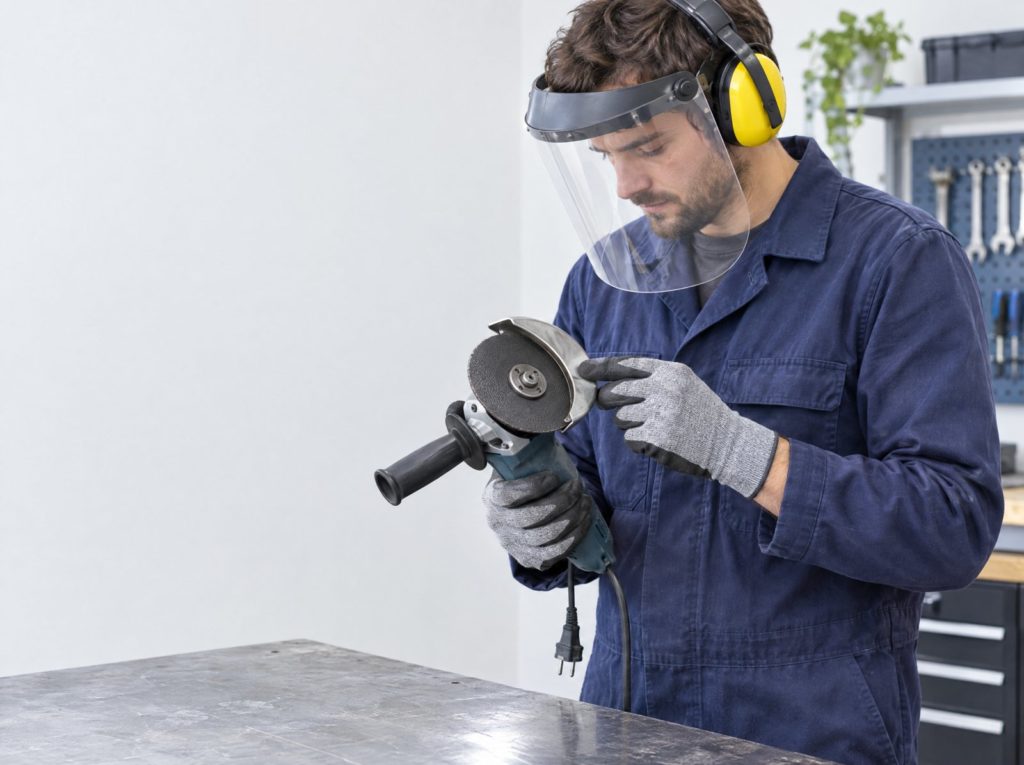
Abrasive wheels include grinding wheels, cutting discs and flap discs used on angle grinders, cut-off saws and bench grinders. If a wheel bursts at operating speed, fragments can fly out with enough force to kill. Many other injuries come from contact with the wheel, kickback and flying particles.
What the law says
The old Abrasive Wheels Regulations 1970 were revoked in 1998. Abrasive wheels are now covered by PUWER, which requires work equipment to be suitable, maintained, guarded and used only by people who have received adequate training. HSE’s guidance HSG17, Safety in the use of abrasive wheels, sets out good practice, and the practice of only letting trained and competent people mount wheels continues.
Before mounting a wheel
- Check the wheel is the right type for the machine and the job.
- Check its maximum operating speed, marked on the wheel. It must be equal to or higher than the maximum speed of the machine spindle.
- Check the expiry date on resin-bonded wheels and discs, usually stamped on the metal centre ring.
- Inspect it for cracks, chips or damage. A ring test can help detect cracks in vitrified wheels.
- Use the correct flanges and blotters, and never force a wheel onto a spindle.
- Run the machine with the guard in place, standing to one side, before use.
Safe use
- Keep the guard in place and correctly adjusted. Never remove it.
- On bench grinders, keep the work rest within 3 mm of the wheel.
- Do not grind on the side of a wheel designed for its edge.
- Wear eye or face protection, hearing protection and gloves where the risk assessment says so.
- Control dust, especially when cutting concrete or stone, which creates silica dust.
- Manage hand-arm vibration exposure.
- Store wheels in a dry, frost free place on racks, so they are not damaged.
Training
Anyone who mounts, uses or supervises the use of abrasive wheels must be trained and competent. Training should cover hazards, wheel markings and speeds, storage and handling, inspection, mounting, guards, PPE and safe use. Keep records of who has been trained, and only allow trained people to change wheels.
Common causes of wheel failure
- Running a wheel faster than its maximum operating speed, for example a large disc fitted to a fast small grinder
- Using a damaged, out of date or wrong wheel
- Over-tightening or using the wrong flanges
- Excessive pressure, or jamming a cutting disc in the cut
- Removing the guard to fit a larger wheel
Training that helps
Our abrasive wheel safety training covers mounting and safe use, and is suitable for construction, manufacturing and maintenance teams. For supervisors and managers, IOSH Managing Safely and the NEBOSH National General Certificate cover work equipment risks within the wider framework.
Frequently asked questions
Are the Abrasive Wheels Regulations 1970 still in force?
No. They were revoked in 1998. Abrasive wheels are now covered by PUWER 1998 and HSE guidance HSG17.
Do you need training to change a grinding disc?
Yes. PUWER requires anyone using work equipment to be adequately trained, and good practice is that only trained, competent people mount wheels.
Do cutting discs have an expiry date?
Resin-bonded wheels and discs usually do, marked on the metal centre. Out of date discs should not be used.
What is a ring test?
A simple check where a vitrified wheel is lightly tapped. A clear ring suggests no cracks; a dull sound suggests damage.
Read the source
The Provision and Use of Work Equipment Regulations 1998; HSE HSG17, Safety in the use of abrasive wheels; and BS EN 12413, safety requirements for bonded abrasive products. Facts checked on 6 October 2026.
Find a date that works
Every course, every centre, with live availability and prices.
On your site or ours, and group rates on request.