&
& 

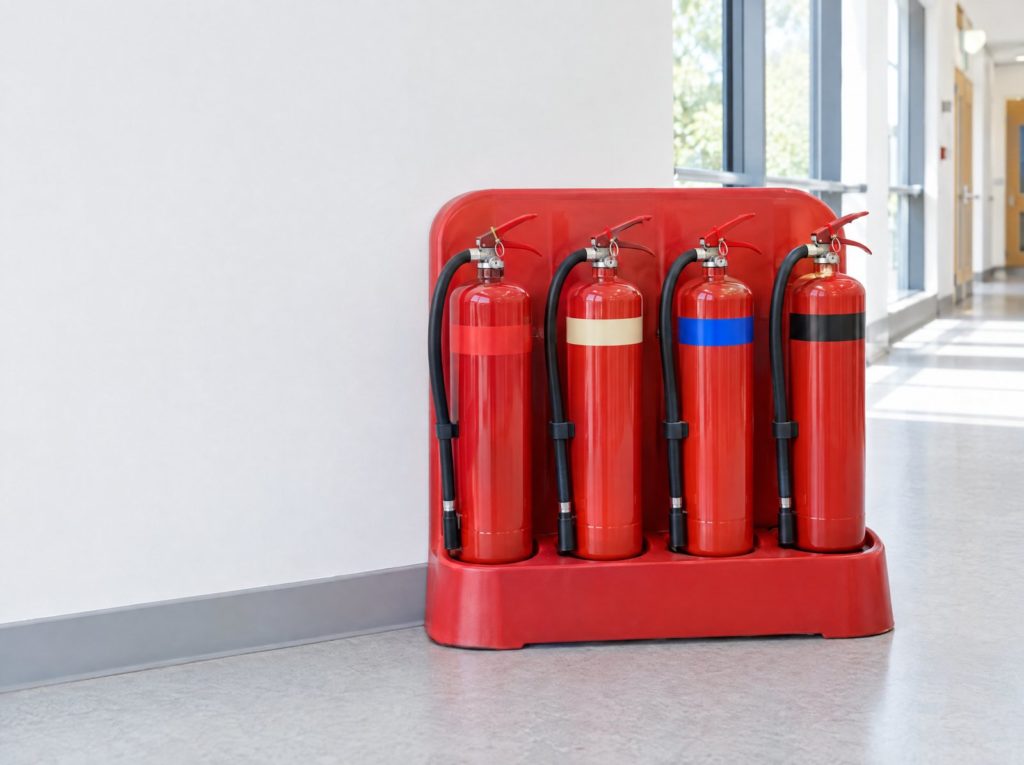
In the UK, all new fire extinguishers have red bodies, with a coloured band or panel showing what they contain. Using the wrong one can make a fire worse or put the user at risk, so knowing the colours and the fire classes matters.
The fire triangle
A fire needs three things: heat, fuel and oxygen. Take one away and the fire goes out. Every extinguisher works by removing one or more of them, by cooling, smothering or interrupting the chemical reaction. Some guides add a fourth side, the chemical chain reaction, to make a fire tetrahedron.
Classes of fire
| Class | What is burning | Examples |
|---|---|---|
| A | Solid combustible materials | Wood, paper, cardboard, textiles, plastics |
| B | Flammable liquids | Petrol, diesel, solvents, paints |
| C | Flammable gases | Propane, butane, natural gas |
| D | Metals | Magnesium, aluminium swarf, lithium |
| F | Cooking oils and fats | Deep fat fryers |
| Electrical | Live electrical equipment | Not a class in its own right, but extinguisher labels show whether they are safe to use on it |
Extinguisher types and colours
| Type | Colour band | Use on | Never use on |
|---|---|---|---|
| Water | Red (all red) | Class A | Flammable liquids, electrical equipment, cooking oil |
| Foam | Cream | Class A and B | Cooking oil, and electrical equipment unless tested and labelled as safe |
| Carbon dioxide (CO2) | Black | Electrical fires and class B | Cooking oil. Limited effect on class A. Can cause cold burns, so hold by the handle and horn correctly. |
| Dry powder | Blue | Class A, B and C, and electrical fires | Cooking oil. Not recommended in enclosed spaces, as the powder cloud reduces visibility and can be inhaled. |
| Wet chemical | Yellow | Class F and class A | Most other fires |
| Specialist powder | Blue, specialist type | Class D metal fires | Other fire classes |
Using an extinguisher: PASS
- Pull the pin, breaking the seal.
- Aim at the base of the fire, not the flames.
- Squeeze the handle.
- Sweep from side to side until the fire is out.
Only tackle a fire if you have been trained, the fire is small, you have the right extinguisher, the alarm has been raised and you have a clear escape route behind you. If in doubt, get out.
How many extinguishers, and where?
The number and type depend on the fire risk assessment. As a guide, extinguishers are usually sited on escape routes, near exits and next to specific risks such as kitchens or plant rooms, and they must be serviced regularly by a competent person. Our guide to the Fire Safety Order explains the legal duties behind this.
Training that helps
Our fire warden and marshal training includes using extinguishers safely, and our fire extinguisher eLearning is a quick online option. For anyone managing fire safety, the NEBOSH Certificate in Fire Safety covers fire science, risk assessment and fire protection in depth.
Frequently asked questions
What colour is a CO2 fire extinguisher?
Red with a black band or label.
Which fire extinguisher is used for electrical fires?
CO2 is the most common choice. Dry powder can also be used, but is not recommended in enclosed spaces.
Can you use water on an electrical fire?
No. Water conducts electricity and can cause electric shock.
What extinguisher is used on a chip pan fire?
A wet chemical extinguisher, with a yellow band, or a fire blanket. Never use water.
What are the three sides of the fire triangle?
Heat, fuel and oxygen.
Read the source
BS EN 3, Portable fire extinguishers; BS 5306-8, selection and positioning of portable fire extinguishers; BS EN 2, classification of fires; and fire and rescue service guidance on fire extinguishers. Facts checked on 6 October 2026.
Find a date that works
Every course, every centre, with live availability and prices.
On your site or ours, and group rates on request.