&
& 

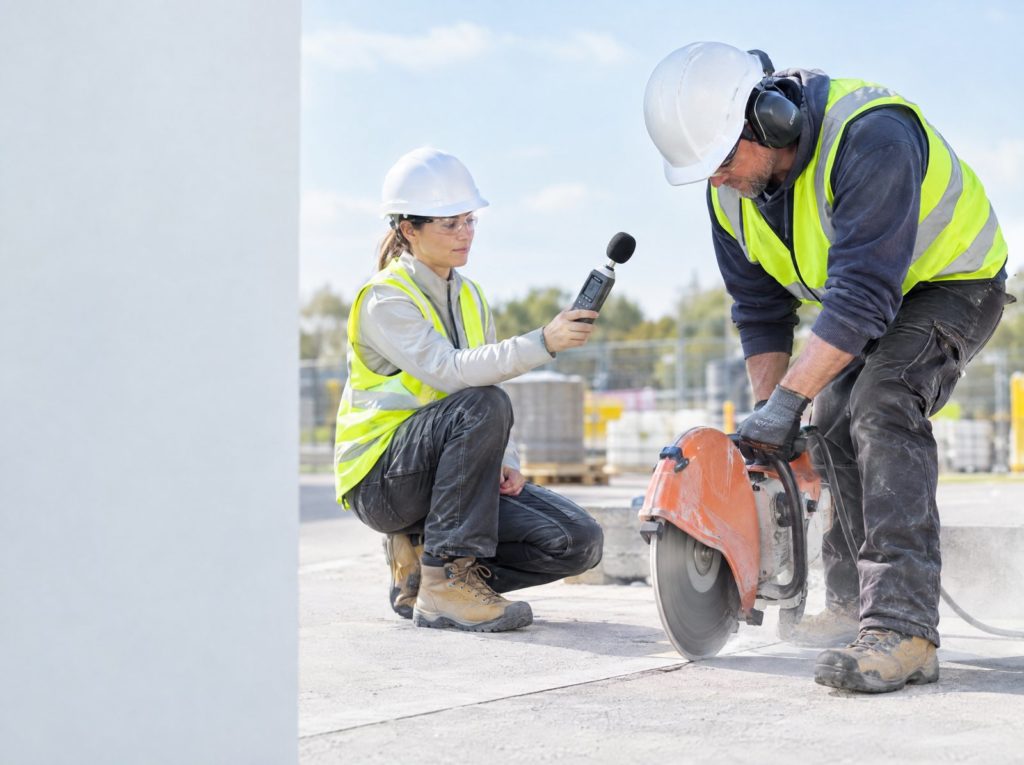
Noise-induced hearing loss is permanent and completely preventable. The Control of Noise at Work Regulations 2005 set the levels at which employers must act, and construction is one of the industries most affected, with breakers, saws, grinders and plant all exceeding the action values in a short time.
The action values and limits
| Level | Daily or weekly exposure | Peak sound pressure | What employers must do |
|---|---|---|---|
| Lower exposure action value | 80 dB(A) | 135 dB(C) | Assess the risk, provide information and training, and make hearing protection available to those who ask |
| Upper exposure action value | 85 dB(A) | 137 dB(C) | Reduce exposure with a programme of control measures, set up hearing protection zones and make hearing protection mandatory |
| Exposure limit value | 87 dB(A) | 140 dB(C) | Must not be exceeded. Unlike the action values, this takes account of hearing protection. |
Simple tests for when a noise assessment is needed
- People have to raise their voices to be heard at about 2 metres for at least part of the day
- People use noisy powered tools or machinery for more than half an hour a day
- The work is in a noisy industry such as construction, demolition or road repair
- There are impact noises, such as hammering, drop forging or cartridge tools
- People have muffled hearing at the end of the day, even if it is better by the next morning
If any of these apply, a competent person should assess exposure, using measurements or reliable data about the tools and how long they are used.
Controlling noise
- Eliminate or change the method. Use bursting or crushing instead of breaking, cast-in fixings instead of drilling.
- Choose quieter equipment. Ask hire companies for noise data and choose low-noise tools and plant.
- Reduce noise at source. Maintain equipment, fit silencers and keep panels closed.
- Screen and separate. Use barriers and enclosures, and move noisy work away from others.
- Limit exposure time. Rotate jobs and plan noisy work.
- Hearing protection. As a last resort and alongside the measures above, never instead of them.
Getting hearing protection right
- Choose protection that reduces noise to below 85 dB(A) at the ear, but not so much that people cannot hear warnings. Over-protection is a real risk.
- Wear it all the time in noisy areas. Taking it off for even a few minutes greatly reduces the protection over the day.
- Make sure it fits, is compatible with hard hats and glasses, and is kept clean and in good condition.
- Train people to fit earplugs properly, because a poorly fitted plug gives little protection.
Health surveillance
Employers must provide health surveillance, usually regular hearing checks, for workers likely to be regularly exposed above the upper exposure action value, or at risk for any other reason. Our guide to health surveillance explains how it works.
Noise and vibration often go together
Many of the noisiest tools also cause hand-arm vibration, so it makes sense to assess and control both together.
The ACoP and official guidance
| Publication | Status | What it covers |
|---|---|---|
| L108 Controlling noise at work (3rd edition, 2021) | ACoP and guidance | Assessing exposure, the action and limit values, controls, hearing protection and health surveillance. |
An Approved Code of Practice (ACoP) has special legal status under section 16 of the Health and Safety at Work Act. If you are prosecuted and did not follow it, you must show that you met the law in some other way that was just as good. Guidance on Regulations has no special legal status, but inspectors refer to it and following it is normally enough to comply. Our guide to UK health and safety legislation lists every law and its ACoP or guidance in one place.
Training that helps
Our noise eLearning covers the regulations and controls for workers and supervisors, and pairs well with our hand-arm vibration eLearning. For managers, noise is covered in the NEBOSH National General Certificate.
Where this fits in SMSTS and SSSTS
Noise action values and the signs that an assessment is needed are tested on both papers. Our free SMSTS mock test and SSSTS mock test let you check your knowledge before the course or a refresher, and you can email yourself the results sheet at the end.
When you are ready, the five day SMSTS course is for site managers and the two day SSSTS course is for supervisors. If your certificate is due, the SMSTS refresher and SSSTS refresher keep it current.
Frequently asked questions
What is the noise exposure limit value?
87 dB(A) daily or weekly exposure, or 140 dB(C) peak, taking account of hearing protection.
At what level must hearing protection be worn?
At or above the upper exposure action value of 85 dB(A), hearing protection is mandatory. At 80 dB(A) it must be made available to anyone who asks.
How do I know if a noise assessment is needed?
If people have to raise their voices to be heard at about 2 metres, use noisy powered tools for more than half an hour a day, or have muffled hearing after work, an assessment is likely to be needed.
Is hearing loss from noise permanent?
Yes. Noise-induced hearing loss and tinnitus cannot be cured, which is why prevention matters.
Read the source
The Control of Noise at Work Regulations 2005, regulations 4 to 9; HSE guidance L108, Controlling noise at work; HSE leaflet INDG362, Noise at work; and HSE guidance on noise in construction. Facts checked on 6 October 2026.
Find a date that works
Every course, every centre, with live availability and prices.
On your site or ours, and group rates on request.