&
& 

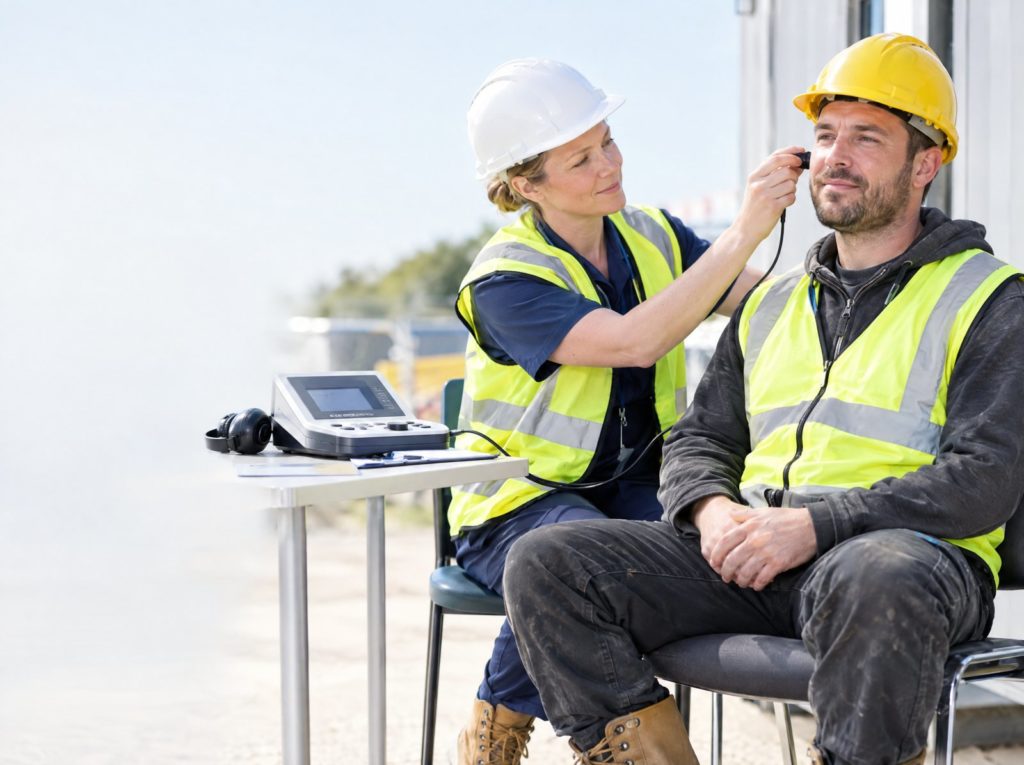
Health surveillance is a system of ongoing health checks for workers exposed to specific health risks. Its purpose is to spot early signs of work-related ill health, such as hearing loss, dermatitis or vibration white finger, so action can be taken before it gets worse, and to check that controls are working.
When is health surveillance required?
The Management of Health and Safety at Work Regulations 1999 require employers to provide appropriate health surveillance where the risk assessment shows it is needed. In practice, it is required when all of these apply:
- There is an identifiable disease or adverse health effect linked to the work
- There are valid techniques to detect it
- There is a reasonable likelihood it may occur in the conditions of the work
- Surveillance is likely to benefit the worker
Common examples on construction sites
| Risk | Trigger | Typical surveillance |
|---|---|---|
| Noise | Regular exposure above the upper exposure action value of 85 dB(A) | Regular hearing tests (audiometry) |
| Hand-arm vibration | Regular exposure above the exposure action value of 2.5 m/s² A(8) | Questionnaires, then assessment by a qualified person where symptoms are reported |
| Respirable crystalline silica | Regular exposure from cutting, chasing, drilling or grinding concrete, stone and brick | Respiratory questionnaires and lung function tests, with periodic assessment |
| Skin sensitisers and irritants | Wet cement, epoxy resins, solvents and frequent wet work | Regular skin checks by a trained responsible person |
| Respiratory sensitisers | Isocyanates in some paints and foams, wood dust | Respiratory questionnaires and lung function tests |
| Lead and asbestos | Specific regulations set the requirements | Medical surveillance by an appointed doctor where required |
Our guides to noise, hand-arm vibration and COSHH explain these risks and their controls.
Health surveillance, health monitoring and medicals
| Term | What it means |
|---|---|
| Health surveillance | A legal requirement where workers are exposed to specific health risks, to detect early signs of ill health. |
| Fitness for work assessment | Checks that someone is fit for a particular role, such as a plant operator or someone working at height. |
| Health promotion or wellbeing checks | Voluntary checks such as blood pressure tests. Useful, but not health surveillance. |
Who carries it out?
It depends on the risk. Simple skin checks can be done by a trained responsible person within the business. Hearing tests, lung function tests and vibration assessments need an occupational health professional, such as an occupational health nurse or doctor. Many construction firms use an occupational health provider that visits site.
Records
- Keep a health record for each worker under surveillance, showing the checks done and the outcome, but not confidential medical details.
- Medical information stays confidential between the worker and the health professional.
- Some records must be kept for a long time, for example 40 years for health records relating to hazardous substances under COSHH.
Acting on the results
Surveillance only helps if someone acts on it. If it shows early signs of ill health, review the risk assessment and controls, consider whether the worker should move to other work, and check whether others doing the same job are affected. Some diagnosed conditions must be reported under RIDDOR.
Training that helps
Occupational health is covered in the NEBOSH National General Certificate and the NEBOSH Health and Safety Management for Construction certificate. Our COSHH awareness eLearning, noise eLearning and hand-arm vibration eLearning help workers understand why surveillance matters.
Where this fits in SMSTS and SSSTS
Occupational health and health surveillance are tested on both papers. Our free SMSTS mock test and SSSTS mock test let you check your knowledge before the course or a refresher, and you can email yourself the results sheet at the end.
When you are ready, the five day SMSTS course is for site managers and the two day SSSTS course is for supervisors. If your certificate is due, the SMSTS refresher and SSSTS refresher keep it current.
Frequently asked questions
Is health surveillance a legal requirement?
Yes, where the risk assessment shows workers are exposed to specific health risks that can be detected early, such as noise, vibration, silica dust or skin sensitisers.
Who pays for health surveillance?
The employer. Workers must not be charged for health surveillance required by law.
How long must health surveillance records be kept?
It depends on the risk. Records relating to hazardous substances under COSHH must be kept for 40 years.
Is a wellbeing check the same as health surveillance?
No. Wellbeing checks are voluntary. Health surveillance is a legal requirement for specific workplace health risks.
Read the source
The Management of Health and Safety at Work Regulations 1999, regulation 6; the Control of Substances Hazardous to Health Regulations 2002, regulation 11; the Control of Noise at Work Regulations 2005, regulation 9; the Control of Vibration at Work Regulations 2005, regulation 7; and HSE guidance on health surveillance, including HSE’s health surveillance pages for construction. Facts checked on 6 October 2026.
Find a date that works
Every course, every centre, with live availability and prices.
On your site or ours, and group rates on request.