&
& 

HSG47, Avoiding danger from underground services, is HSE’s guidance for anyone digging near buried cables and pipes. Striking an electricity cable can cause severe burns or death, and damaging a gas main can cause fire or explosion. HSG47 sets out a simple three-part approach that, followed properly, prevents most service strikes.
The three elements of a safe system
| Element | What it involves |
|---|---|
| Planning the work | Get service plans from the utility companies and the client, look for clues on site, and plan the dig before work starts. |
| Detecting, identifying and marking | Use trained operatives with locating devices to trace services, then mark them clearly on the ground. |
| Safe excavation | Dig carefully near marked services, expose them by hand and support them once exposed. |
Planning: plans are only a starting point
Service plans are essential, but they are often inaccurate, out of date or incomplete. Depths are rarely shown, services move, and many private cables, such as street lighting or supplies to outbuildings, are not recorded at all. Treat every plan as an indication, not a guarantee, and look for clues on site such as manhole covers, valve boxes, lamp posts and reinstated trenches. Good pre-construction information should include whatever service information the client has.
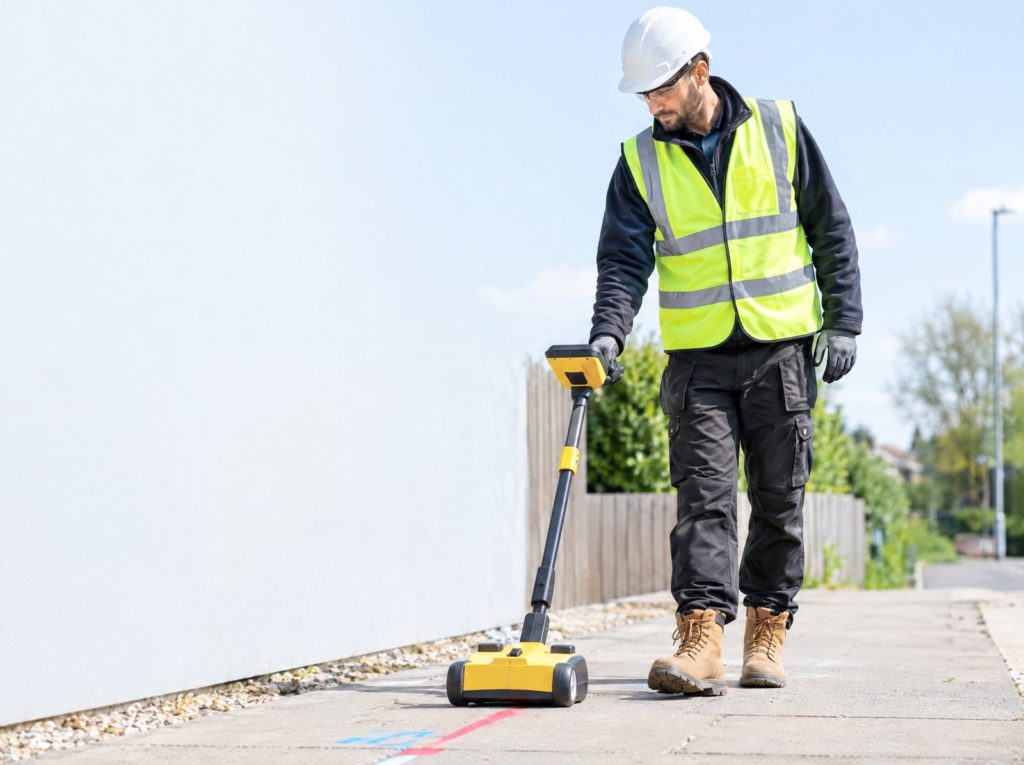
Detecting: CAT and Genny
| Tool or mode | What it does | Limits |
|---|---|---|
| Cable avoidance tool (CAT), power mode | Detects electromagnetic signals from live cables carrying a load | Will not find cables carrying little or no current |
| CAT, radio mode | Detects radio signals picked up and re-radiated by long metallic services | Signals vary and may not show every service |
| Signal generator (Genny) | Applies a signal to a metallic service or a sonde so the CAT can trace it | Needs access to the service or a way to apply the signal |
| Ground penetrating radar | Detects changes in the ground, including non-metallic pipes | Needs specialist operators and interpretation |
Plastic pipes and ducts without a tracer wire, and many non-metallic services, cannot be found with a CAT alone. Scan before digging and repeatedly as the excavation gets deeper, because a service missed at the surface may show up further down.
Marking
Mark the line of each located service clearly on the ground, using paint or markers that will last for the duration of the work, and record it on a drawing or permit to dig. Utility colour codes can help identify services once exposed, but colours fade and services are not always the colour you expect, so treat colour as a clue, not proof.
Safe digging
- Use a permit to dig where the risk justifies it, so locating and marking are confirmed before excavation starts.
- Dig trial holes by hand to confirm the position and depth of services.
- Do not use hand-held power tools or mechanical excavators close to the indicated line of a service. HSG47 advises hand digging near services, using insulated tools and careful techniques.
- Assume every service is live until proven otherwise.
- Support exposed services and do not use them as steps or handholds.
- Backfill properly, with any warning tape or tiles replaced.
If you strike a service
- Stop work and keep everyone away, especially from damaged electricity cables and leaking gas.
- Do not touch a damaged cable or the plant in contact with it.
- Call the emergency number of the utility company, and the emergency services if anyone is hurt or there is gas or fire.
- Report the incident. Some service strikes are reportable under RIDDOR as dangerous occurrences.
Overhead power lines
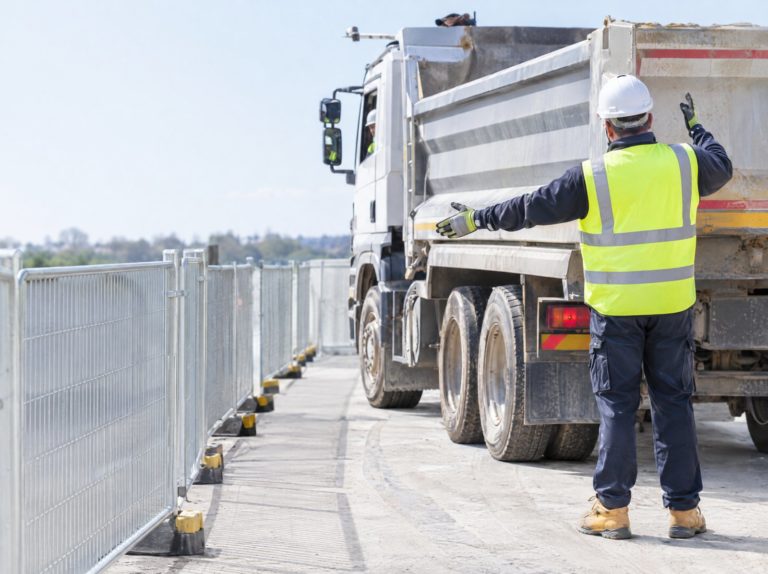
HSE’s guidance GS6 covers the other side of the problem: plant such as excavators, tipper lorries, cranes and concrete pumps touching overhead lines. Contact can be fatal for the driver and anyone touching the machine. Plan routes and work areas to keep plant away, use barriers and goalposts at crossing points, and contact the line owner about diversion or isolation.
Training that helps
Operatives who locate services need hands-on training with the equipment they use, such as our CAT and Genny cable avoidance training. Our permit to work eLearning covers permits to dig, and our guide to safe systems of work shows how locating, marking and digging fit into a wider safe system. Underground and overhead services are covered in depth on SMSTS and SSSTS.
Where this fits in SMSTS and SSSTS
Underground and overhead services, including when to use a CAT and why plans are not enough, are tested on both papers. Our free SMSTS mock test and SSSTS mock test let you check your knowledge before the course or a refresher, and you can email yourself the results sheet at the end.
When you are ready, the five day SMSTS course is for site managers and the two day SSSTS course is for supervisors. If your certificate is due, the SMSTS refresher and SSSTS refresher keep it current.
Frequently asked questions
What is HSG47?
HSE’s guidance Avoiding danger from underground services, which explains how to plan, locate, mark and dig safely near buried services.
Can I rely on service plans?
No. Plans are a starting point, but they are often inaccurate or incomplete. Always locate services on site before digging.
When should a CAT be used?
Before digging starts, and repeatedly as the excavation goes deeper, because services missed near the surface may be found further down.
Does a CAT find plastic pipes?
Not on its own. Plastic pipes without a tracer wire need other methods, such as a sonde with a signal generator, ground penetrating radar or careful hand digging.
Read the source
HSE guidance HSG47, Avoiding danger from underground services (fourth edition); HSE guidance GS6, Avoiding danger from overhead power lines; the Construction (Design and Management) Regulations 2015, regulation 25; and the Reporting of Injuries, Diseases and Dangerous Occurrences Regulations 2013, Schedule 2. Facts checked on 6 October 2026.
Upcoming CITB Site Safety dates
Straight from the booking system, so this block is never out of date.
Prices exclude VAT. Dates and places update automatically.