&
& 

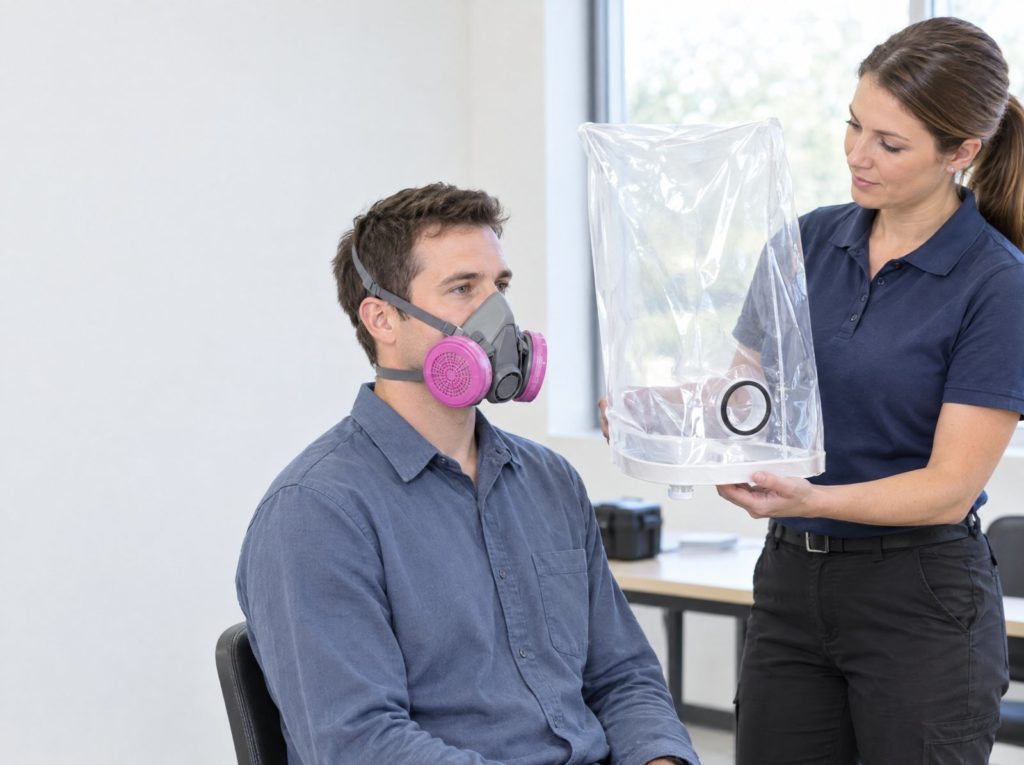
Respiratory protective equipment, or RPE, protects people from breathing in hazardous dust, fumes, vapours and gases. Tight-fitting respirators only work if they seal properly to the wearer’s face, and faces come in very different shapes and sizes. A face fit test checks that a particular model and size of respirator seals on a particular person.
Who needs a face fit test?
Anyone who wears tight-fitting RPE at work, including disposable FFP1, FFP2 and FFP3 masks, half masks and full face masks. HSE expects fit testing as part of the duties under COSHH, the Control of Asbestos Regulations and the Control of Lead at Work Regulations. Loose-fitting RPE such as powered hoods and helmets does not need a fit test, which makes it a useful option for people who cannot achieve a seal.
Qualitative and quantitative tests
| Method | How it works | Suitable for |
|---|---|---|
| Qualitative | The wearer puts on the mask and a hood, and a bitter or sweet solution is sprayed in. If they can taste it, the mask is leaking. | Disposable masks and half masks |
| Quantitative | An instrument measures particles inside and outside the mask and calculates a fit factor. | Disposable masks, half masks and full face masks. Full face masks must be tested this way. |
In both methods, the wearer carries out a set of exercises, such as talking, bending and moving the head, to mimic real work. The test should be carried out by a competent tester, and the Fit2Fit accreditation scheme, run with the British Safety Industry Federation, is a recognised way to check competence.
The clean shaven rule
Stubble, beards and moustaches that cross the sealing surface stop a tight-fitting mask from sealing. The wearer should be clean shaven where the mask seals, both for the test and every time they wear it. Even a day’s growth can make a difference. Where someone cannot be clean shaven, for religious or other reasons, loose-fitting powered RPE is usually the answer.
When to repeat the test
- When the wearer changes to a different model, size or material of mask
- When they gain or lose a significant amount of weight
- After dental work or anything else that changes the face shape
- When they start wearing other PPE, such as glasses, that could affect the seal
- Periodically: industry guidance from Fit2Fit suggests a repeat test every two years
Fit testing is not the whole answer
A fit test is one part of an RPE programme. The RPE must also be adequate for the hazard, with the right assigned protection factor, and suitable for the wearer and the task. Wearers need training in putting it on, doing a pre-use seal check, storing it and changing filters. Records of fit tests, training and maintenance should be kept. Our guide to workplace exposure limits explains how to tell how much protection is needed.
Training that helps
Our COSHH awareness training and COSHH eLearning explain how RPE fits into controlling hazardous substances. For construction dust and asbestos, see our UKATA asbestos awareness course. Managers who select controls will find the NEBOSH National General Certificate and IOSH Managing Safely cover RPE and the hierarchy of controls.
Frequently asked questions
Is face fit testing a legal requirement?
HSE guidance under COSHH and related regulations expects tight-fitting RPE to be fit tested, and the ACoPs say the RPE must fit the wearer. In practice, fit testing is how employers show this.
Do FFP3 disposable masks need a fit test?
Yes. All tight-fitting masks, including disposable FFP1, FFP2 and FFP3, need a fit test.
How often should face fit testing be done?
Whenever something changes, such as a new mask model or a change in face shape. Industry guidance suggests repeating it every two years.
Can you pass a face fit test with a beard?
Not with a tight-fitting mask where hair crosses the seal. Loose-fitting powered RPE is the usual alternative.
Read the source
HSE INDG479, Guidance on respiratory protective equipment fit testing; HSE HSG53, Respiratory protective equipment at work; the COSHH Approved Code of Practice L5; and Fit2Fit guidance documents. Facts checked on 6 October 2026.
Find a date that works
Every course, every centre, with live availability and prices.
On your site or ours, and group rates on request.