&
& 

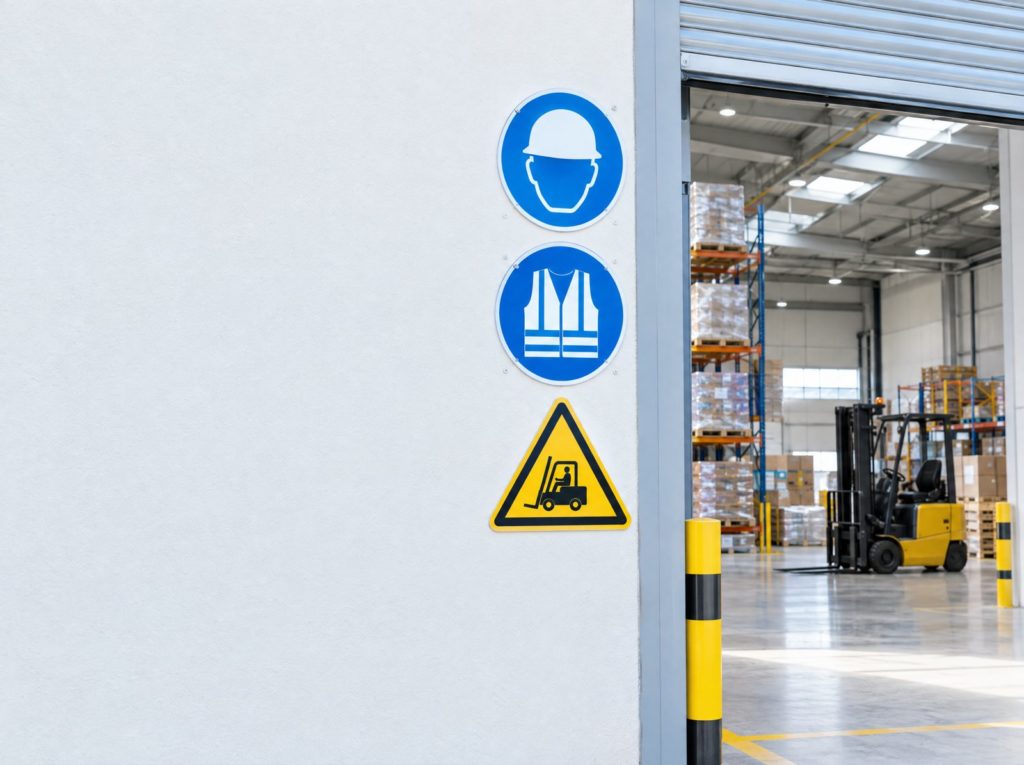
Safety signs give quick, clear information about hazards and what people must or must not do. The Health and Safety (Safety Signs and Signals) Regulations 1996 require employers to use them where a risk cannot be avoided or adequately reduced in other ways, and to make sure employees understand what they mean.
The four main types of sign
| Type | Shape and colour | Meaning | Examples |
|---|---|---|---|
| Prohibition | Red circle with a diagonal bar, black symbol on white | You must not | No smoking, no access, do not use mobile phones |
| Warning | Yellow triangle with a black border and symbol | Danger, be careful | Forklift trucks operating, electrical hazard, slippery floor |
| Mandatory | Blue circle with a white symbol | You must | Wear hard hats, wear eye protection, wear hi-vis |
| Safe condition | Green rectangle or square with a white symbol | Safety equipment or escape | Fire exit, first aid, emergency eyewash, assembly point |
Fire equipment signs, such as those showing the location of a fire extinguisher, hose reel or call point, are white symbols on a red square or rectangle.
What the regulations require
- Provide safety signs where the risk assessment shows a risk that cannot be avoided or adequately controlled by other means
- Use signs that meet the regulations, including the standard colours and shapes. Signs to BS EN ISO 7010 meet these requirements.
- Maintain signs so they stay visible and legible
- Explain the meaning of signs to employees, along with what they should do
- Use other signals where needed, such as illuminated signs, acoustic signals, hand signals and verbal communication
Signs are not a control on their own
A sign does not remove a hazard. It should support other controls in the hierarchy of controls, not replace them. Too many signs in one place can also mean none of them are read, so keep them relevant and remove ones that no longer apply.
Pipework and containers
Containers and pipework carrying hazardous substances must be labelled. Containers use the hazard pictograms from the classification and labelling rules, and pipework can be marked with the pictograms and the substance name at key points.
Hand signals
The regulations also set out hand signals, for example for directing lifting operations and vehicles. These include start, stop, emergency stop, raise, lower, and move in a direction. Banksmen and signallers must use the standard signals so that drivers and crane operators understand them. Our guide to construction traffic management covers vehicle marshalling on site.
Fire escape signs
Escape route signs show a running figure and a directional arrow on green, and must lead people all the way to a final exit. They should be visible in an emergency, which may mean illuminated or photoluminescent signs. The fire risk assessment should confirm they are in the right places.
Training that helps
Our safety hazards eLearning and health and safety induction eLearning cover safety signs for all staff. In construction, CITB’s Health and Safety Awareness course explains site signs. For managers, IOSH Managing Safely and the NEBOSH National General Certificate cover safety signs within the wider legal framework.
Frequently asked questions
What do the colours of safety signs mean?
Red means prohibition or fire equipment, yellow means warning, blue means mandatory and green means safe condition or escape.
What shape is a mandatory sign?
A blue circle with a white symbol.
Are safety signs a legal requirement?
Yes, where a risk cannot be avoided or adequately controlled by other means, under the Safety Signs and Signals Regulations 1996.
What standard do safety signs follow?
Signs to BS EN ISO 7010 meet the requirements of the 1996 regulations.
Read the source
The Health and Safety (Safety Signs and Signals) Regulations 1996; HSE L64, Safety signs and signals, guidance on the regulations; and BS EN ISO 7010, graphical symbols and registered safety signs. Facts checked on 6 October 2026.
Find a date that works
Every course, every centre, with live availability and prices.
On your site or ours, and group rates on request.