&
& 

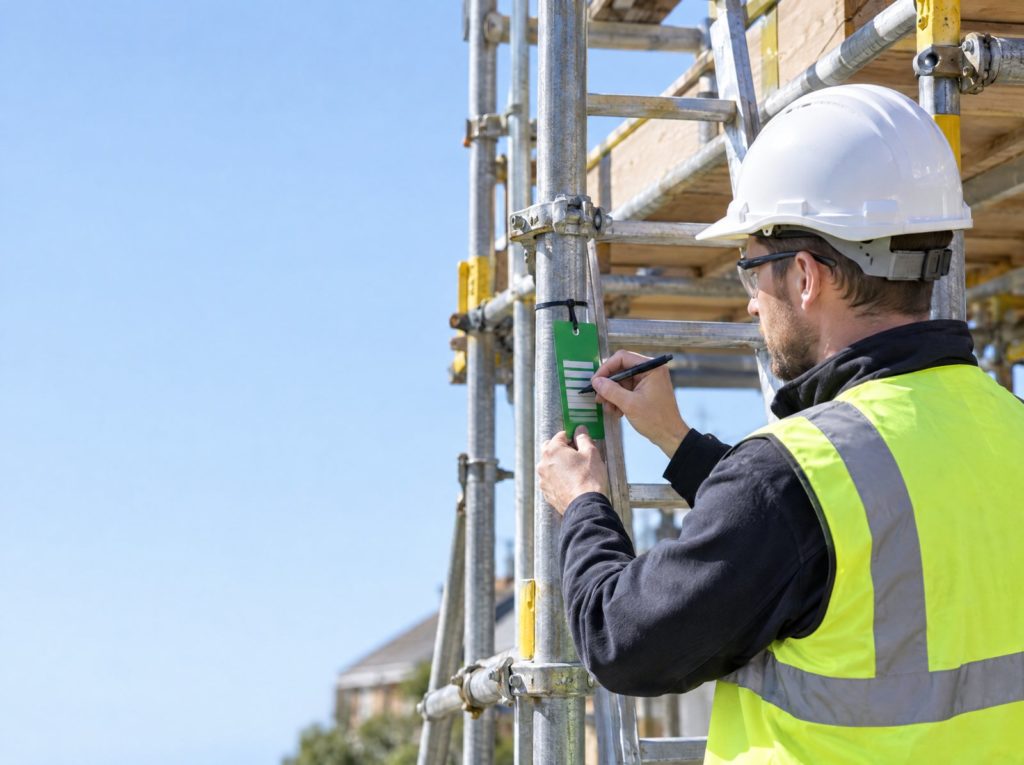
A scaffold tag is a label fixed at each access point of a scaffold to show whether it is safe to use and when it was last inspected. Tags are widely used and very useful, but they are not the same as the legal inspection and report, and a green tag on its own does not make a scaffold compliant.
What the colours mean
| Tag | Usual meaning |
|---|---|
| Green, or a tag showing a valid recent inspection | Inspected and safe to use for its intended purpose. |
| Red, or a tag with the insert removed | Do not use. The scaffold is incomplete, being altered or has failed inspection. |
| Amber or yellow, used on some sites | Restricted use, for example only by scaffolders, or with conditions noted on the tag. |
The colours are an industry convention, not set by law, so always read the tag and follow the site’s own rules.
Are scaffold tags a legal requirement?
No. HSE has said it is not a legal requirement to use scaffold tag systems. The legal requirements are the inspections and written reports set out in the Work at Height Regulations 2005. Tags are a supplement that makes it easy for workers to see the status at a glance. The National Access and Scaffolding Confederation (NASC) also treats tags as supplementary to the formal inspection report.
When a scaffold must be inspected
Regulation 12 of the Work at Height Regulations 2005 requires a competent person to inspect a scaffold:
- After it is erected or assembled and before it is first used
- At suitable intervals while it is in use
- After any event that could affect its safety, such as high winds, an impact, alteration or a period of disuse
- At least every 7 days where it is a working platform used for construction work from which a person could fall 2 metres or more
Our guide to the Work at Height Regulations 2005 covers the wider duties.
What the inspection report must contain
For construction work, the person who inspects must prepare a written report before the end of the working period and give it, or a copy, to the person they inspected for within 24 hours. Schedule 7 of the regulations says the report must include:
- The name and address of the person for whom the inspection was carried out
- The location of the work equipment inspected
- A description of the work equipment inspected
- The date and time of the inspection
- Details of any matter identified that could give rise to a risk to anyone’s health or safety
- Details of any action taken as a result
- Details of any further action considered necessary
- The name and position of the person making the report
The report must be kept on site until the construction work is completed, and then at an office of the person it was made for, for a further three months.
Who is responsible
Scaffolding companies usually inspect after erection and provide a handover certificate. After handover, NASC guidance makes clear that the ongoing 7 day inspections are the duty of the user or hirer, often the principal contractor, unless the scaffold contractor has been engaged to do them. Agree in writing who will carry out each inspection.
Who is competent to inspect
The law requires a competent person, with the knowledge, experience and training for the type of scaffold. The CISRS Scaffold Inspection Training Scheme offers basic and advanced courses for people who inspect scaffolds. Simple scaffolds built to the NASC TG20 guidance come with a compliance sheet, which helps the inspector check the scaffold matches the design.
Evidence that travels with equipment
Where work equipment such as a scaffold or mobile tower leaves one business or is taken over from another, it must come with physical evidence that the last inspection was carried out. A tag or a copy of the latest report does this.
What workers should check before using a scaffold
- A tag or notice showing it has been inspected within the last 7 days
- Guardrails, toe boards and brick guards in place
- Boards complete, secure and not overloaded
- Ladders tied, with the access gate working
- No missing ties, braces or couplers
- No signs of unauthorised alteration
If anything is wrong, do not use the scaffold and report it. Only competent scaffolders should alter a scaffold. With CISRS planning to leave CSCS, our guide on CISRS leaving CSCS in 2027 explains what changes for scaffolders’ cards.
Training that helps
Our working at height eLearning and ladder safety eLearning cover the basics for wider teams. For a recognised card, NPORS N404 Safe Working at Height is a half day course. Supervisors who manage scaffolds and temporary works may also need the Temporary Works Coordinator course.
Where this fits in SMSTS and SSSTS
Work at height and scaffolding inspections are tested on both courses, and supervisors are expected to check inspection records as well as tags. Our free SMSTS mock test and SSSTS mock test let you check your knowledge before the course or a refresher, and you can email yourself the results sheet at the end.
When you are ready, the five day SMSTS course is for site managers and the two day SSSTS course is for supervisors. If your certificate is due, the SMSTS refresher and SSSTS refresher keep it current.
Frequently asked questions
What does a green scaffold tag mean?
Usually that the scaffold has been inspected and is safe to use. Always check the date and any conditions on the tag.
Are scaffold tags a legal requirement?
No. The law requires inspections and written reports. Tags are a widely used way of showing the status.
How often must a scaffold be inspected?
Before first use, after anything that could affect its safety, and at least every 7 days where someone could fall 2 metres or more during construction work.
How long must scaffold inspection reports be kept?
On site until the construction work is completed, then at an office for three months.
Read the source
The Work at Height Regulations 2005, regulation 12 and Schedule 7; HSE guidance on scaffold inspection and on scaffold tagging systems; NASC guidance including TG20 and its guidance on scaffold inspections and handover; and the CISRS Scaffold Inspection Training Scheme. Facts checked on 6 October 2026.
Build your NPORS course
Tell it who is coming and it works out the days, the ratio and how many times it has to run.
Your site or ours. Quoted per group, not per head.