&
& 

LOLER, the Lifting Operations and Lifting Equipment Regulations 1998, sets out how lifting equipment must be chosen, examined and used, and how lifting operations must be planned. It applies on top of PUWER, which covers all work equipment.
What counts as lifting equipment?
Lifting equipment is work equipment for lifting or lowering loads, including its attachments for anchoring, fixing or supporting it. Lifting accessories, such as slings, shackles, eyebolts and lifting beams, are included. On a construction site that means:
- Cranes of all types, including tower, mobile and crawler cranes
- Telehandlers and forklift trucks
- Mobile elevating work platforms (MEWPs) and passenger hoists
- Goods hoists and gin wheels
- Excavators when they are used to lift loads
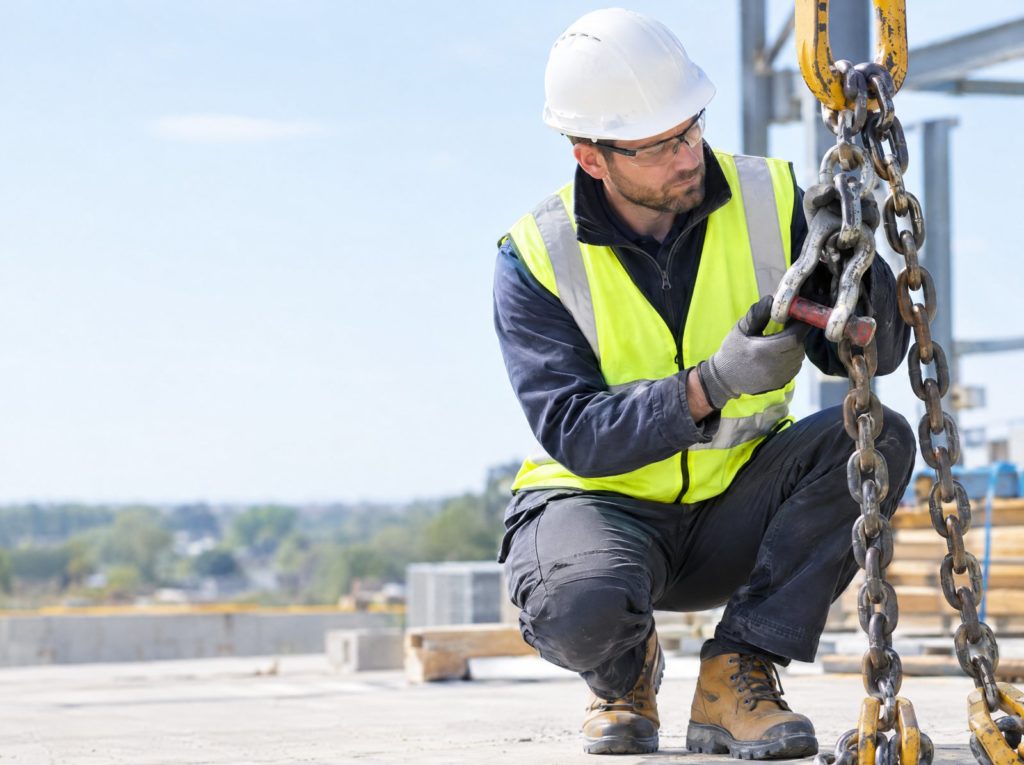
- Lifting accessories: chains, webbing slings, shackles, hooks, eyebolts, lifting frames
Every regulation at a glance
| Regulation | What it requires |
|---|---|
| 4. Strength and stability | Lifting equipment must be strong and stable enough for each use, including the load and anything attached. |
| 5. Lifting persons | Extra safeguards where people are lifted, such as preventing crushing, trapping or falling, and allowing rescue. |
| 6. Positioning and installation | Positioned or installed to reduce the risk of the equipment or load striking people, drifting, falling or being released unintentionally. |
| 7. Marking | Marked with its safe working load, and accessories marked to show their characteristics. Equipment not designed for lifting people must be marked so. |
| 8. Organisation of lifting operations | Every lifting operation must be properly planned by a competent person, appropriately supervised and carried out safely. |
| 9. Thorough examination and inspection | Examined before first use where needed, after installation, periodically and after exceptional circumstances. |
| 10. Reports and defects | Defects reported to the employer straight away, and to the enforcing authority where there is a serious risk. |
| 11. Keeping information | Reports and declarations kept for set periods and available for inspection. |
Thorough examination intervals
| Equipment | Maximum interval |
|---|---|
| Lifting equipment used to lift people | At least every 6 months |
| Lifting accessories | At least every 6 months |
| All other lifting equipment | At least every 12 months |
| Any lifting equipment, alternatively | In line with a written examination scheme drawn up by a competent person |
A thorough examination is also needed after installation, where safety depends on how the equipment is installed or assembled, and after anything that could affect safety, such as damage, a failure, a long period out of use or a major change.
Thorough examination or inspection?
A thorough examination is a detailed, systematic examination by a competent person, usually an engineer from an insurer or specialist company, recorded in a formal report. Inspections are the more frequent checks between examinations, such as pre-use checks and weekly inspections, carried out by a competent person on site where the risk assessment says they are needed. Both matter.
Reports and defects
- The person making the examination must notify the employer straight away of any defect that is or could become a danger.
- A written report must follow as soon as practicable, and within 28 days.
- Where a defect involves an existing or imminent risk of serious personal injury, the examiner must also send a copy of the report to the enforcing authority, usually HSE.
- Equipment with a dangerous defect must not be used until it is put right.
Planning a lift
Regulation 8 requires every lift to be planned by a competent person, supervised and carried out safely. The level of planning depends on the lift. Routine lifts with a forklift may be covered by a generic plan. A tandem crane lift near a live road needs a detailed lifting plan. The British Standard BS 7121 sets out good practice for crane operations, including the roles involved:
| Role | What they do |
|---|---|
| Appointed person | Plans the lift and has overall control of the lifting operation |
| Crane supervisor | Supervises the lift on site in line with the plan |
| Crane operator | Operates the crane safely and in line with instructions |
| Slinger or signaller | Attaches and detaches the load and directs the operator |
Using an excavator to lift
An excavator used as a crane is lifting equipment. It must be suitable for lifting, marked with its rated capacity for the configuration used, fitted with any required safety devices, thoroughly examined under LOLER, and operated by someone trained for lifting operations.
Records to keep
- Declarations of conformity, for as long as the equipment is used
- Reports of examination after installation, for as long as the equipment is used at that place
- Periodic examination reports, until the next report is made or for two years, whichever is later
- Records of inspections, until the next record is made
Training that helps
Our introduction to LOLER eLearning covers the regulations for anyone who uses or manages lifting equipment, and our PUWER eLearning covers the wider work equipment rules. Our slinging and lifting awareness course covers safe use of lifting accessories. For operators, slingers and lift supervisors, see our NPORS courses. Managers will find lifting operations covered in the NEBOSH National General Certificate and the NEBOSH Health and Safety Management for Construction certificate.
Where this fits in SMSTS and SSSTS
Lifting operations, examination intervals and lifting accessories are tested on both papers. Our free SMSTS mock test and SSSTS mock test let you check your knowledge before the course or a refresher, and you can email yourself the results sheet at the end.
When you are ready, the five day SMSTS course is for site managers and the two day SSSTS course is for supervisors. If your certificate is due, the SMSTS refresher and SSSTS refresher keep it current.
Frequently asked questions
What does LOLER stand for?
The Lifting Operations and Lifting Equipment Regulations 1998.
How often do lifting accessories need a thorough examination?
At least every 6 months, or in line with a written examination scheme.
How often does a crane need a thorough examination?
At least every 12 months if it is not used to lift people, or every 6 months if it is, unless a written examination scheme sets different intervals.
Does a forklift come under LOLER?
Yes. Forklift trucks are lifting equipment, so they need thorough examinations under LOLER as well as maintenance under PUWER.
Who can carry out a LOLER thorough examination?
A competent person with the practical and theoretical knowledge and experience to detect defects, and independent enough to make objective judgements.
Read the source
The Lifting Operations and Lifting Equipment Regulations 1998 (SI 1998/2307), regulations 4 to 11 and Schedule 1; HSE Approved Code of Practice and guidance L113, Safe use of lifting equipment; HSE guidance on thorough examination; and BS 7121, Code of practice for safe use of cranes. Facts checked on 6 October 2026.
Find a date that works
Every course, every centre, with live availability and prices.
On your site or ours, and group rates on request.