&
& 

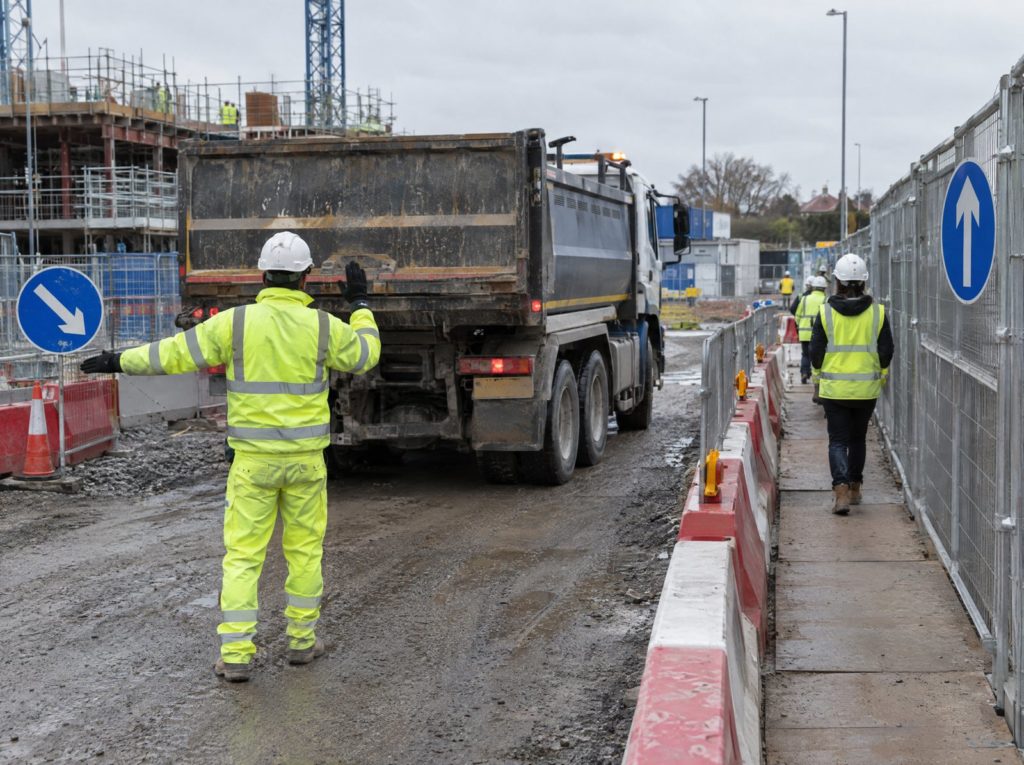
Being struck by a moving vehicle is one of the most common causes of death on construction sites, with reversing vehicles involved in many incidents. CDM 2015 requires sites to be organised so that pedestrians and vehicles can move safely, and the best way to show you have done that is a traffic management plan.
The three principles
| Principle | In practice |
|---|---|
| Keep pedestrians and vehicles apart | Separate pedestrian routes with barriers, separate site entrances for people and vehicles, and exclusion zones around working plant. |
| Minimise vehicle movements | Plan deliveries, use off-site parking for workers, and bring materials close to where they are needed. |
| Reduce reversing | One-way systems, turning areas and drive-through loading so vehicles drive forwards wherever possible. |
When reversing cannot be avoided
- Use trained vehicle marshals or banksmen in a safe position, with agreed signals
- Fit and use visibility aids: cameras, mirrors, proximity sensors and reversing alarms
- Keep pedestrians out of reversing areas
- Stop the vehicle if the marshal is out of sight
What a traffic management plan should include
- A site plan showing vehicle routes, pedestrian routes, crossing points and entrances
- Speed limits and one-way systems
- Delivery arrangements: booking, times, unloading areas and who supervises them
- Loading and unloading procedures, including safe access to vehicle beds
- Parking for site vehicles, plant and workers
- Arrangements for plant, such as exclusion zones and marshals
- Lighting for routes used in darkness
- How the plan is briefed to drivers and workers, and how it is kept up to date as the site changes
Site entrances and the public
Site entrances are where site traffic meets the public. Keep them visible and well signed, control vehicles leaving onto the road, keep the road clean, and make sure pedestrians outside the site are protected. Our guide to construction site set-up covers the wider site layout.
Drivers and visitors
Delivery drivers may not know the site. Give them clear instructions at the gate, explain where they can go and where they must stay, and make sure someone meets them. Drivers should stay in the cab or in a safe area during unloading unless they are needed.
Training that helps
For people guiding vehicles and plant, see our NPORS vehicle marshal and NPORS plant and machinery marshal courses. Our guide to mobile plant safety covers the machines themselves.
Where this fits in SMSTS and SSSTS
Separating vehicles and pedestrians and reducing reversing are tested on SMSTS. Our free SMSTS mock test and SSSTS mock test let you check your knowledge before the course or a refresher, and you can email yourself the results sheet at the end.
When you are ready, the five day SMSTS course is for site managers and the two day SSSTS course is for supervisors. If your certificate is due, the SMSTS refresher and SSSTS refresher keep it current.
Frequently asked questions
What is a construction traffic management plan?
A plan showing how vehicles and pedestrians will move safely around the site, including routes, speed limits, deliveries, reversing arrangements and parking.
What is the best way to reduce reversing accidents?
Design the site so vehicles do not need to reverse, using one-way systems, turning areas and drive-through layouts. Where reversing is unavoidable, use trained marshals and keep pedestrians away.
Do banksmen need training?
Yes. Vehicle marshals and banksmen must be trained and competent, and use agreed signals.
Who is responsible for site traffic management?
The principal contractor plans and manages it on multi-contractor sites. Every contractor must follow the plan and manage its own vehicles and plant.
Read the source
The Construction (Design and Management) Regulations 2015, regulations 27 and 28; HSE guidance HSG144, The safe use of vehicles on construction sites; and HSE guidance on workplace transport. Facts checked on 6 October 2026.
Upcoming CITB Site Safety dates
Straight from the booking system, so this block is never out of date.
Prices exclude VAT. Dates and places update automatically.